Abstract
In the ancient Near East, the judicial ordeal—particularly involving water—functioned as a divinely sanctioned mechanism to determine guilt in the absence of reliable human testimony. This paper explores the practice of water ordeals in Mesopotamia and Anatolia and offers a comparative analysis with the Sotah ritual as found in Numbers 5:11–31. By situating the biblical text within its wider cultural and legal environment, this study examines shared motifs and distinctive theological developments, particularly in relation to divine arbitration, ritual practice, and gender dynamics.
1. Introduction
Trial by ordeal was a common legal recourse across the ancient Near East, utilized when human legal systems could not adequately determine truth due to the lack of credible witnesses or conflicting testimony. Among the most enduring of these ordeals was the water ordeal—a ritual in which divine judgment was invoked through a physical interaction with water. This comparative study places the biblical Sotah ritual within this broader context, examining both shared cultural elements and Israelite innovations.
2. Water Ordeals in the Ancient Near East
2.1 Mesopotamia and the River Ordeal
The river ordeal (mê tamti, “water of the river”) was a prevalent juridical institution in Mesopotamian society, with attestations spanning from the early third millennium BCE into the first millennium. The practice appears in several law codes, including the Code of Ur-Nammu (c. 2100 BCE) and the Code of Hammurabi (c. 1750 BCE), and remained a feature of Mesopotamian legal culture well into the Neo-Babylonian period (Roth, 1995; Van De Mieroop, 2016).
The procedure typically involved compelling the accused (or a proxy) to enter a river. Though the specifics could vary by period or case type, guilt was often determined by sinking (guilty) versus floating (innocent). Crucially, death was not necessarily the outcome for the guilty; rather, the accused might be retrieved from the river and subjected to formal punishment.
The ordeal was invoked in cases involving adultery, sorcery, theft, treason, and disputes over land or property. The god associated with the river ordeal, Idlurugu, was believed to manifest divine judgment through the river’s action. As Finkelstein (1966) notes, the ordeal was not only a procedural test but also a theological act: the river, as a divine agent, was believed to reveal hidden truth.
2.2 Hittite Practice
In the Hittite Kingdom (c. 1600–1180 BCE), while river ordeals are absent from extant legal codes, administrative texts, letters, and royal instructions indicate their continued use. These ordeals were employed particularly for palace personnel and other high-status individuals accused of crimes. The Hittite case suggests that the ordeal was a flexible and adaptable institution across the Near East, even when not codified in written law (Roth, 1995).
2.3 Purpose and Function
The underlying rationale for the ordeal across these societies was the belief that the gods could reveal the truth of past events through natural or ritualized phenomena. While divination (hepatoscopy, astrology) addressed future uncertainties, ordeals were retrospective, establishing divine adjudication in ambiguous circumstances. As such, the ordeal reinforced the authority of divine justice within human legal systems.
3. The Sotah Ritual in Numbers 5:11–31
The ritual of the Sotah presents a highly structured legal-religious response to the suspicion of adultery. In a context where a husband accuses his wife without corroborating witnesses, a procedure is mandated that allows divine intervention to determine her guilt or innocence.
3.1 The Procedure
As outlined in Numbers 5:11–31, the Sotah ritual includes the following elements:
- Initiation: A jealous husband brings his wife to the priest at the Tabernacle.
- Offering: The husband presents a grain offering of jealousy (minḥat qĕnāʾōt), signifying the accusatory nature of the ritual.
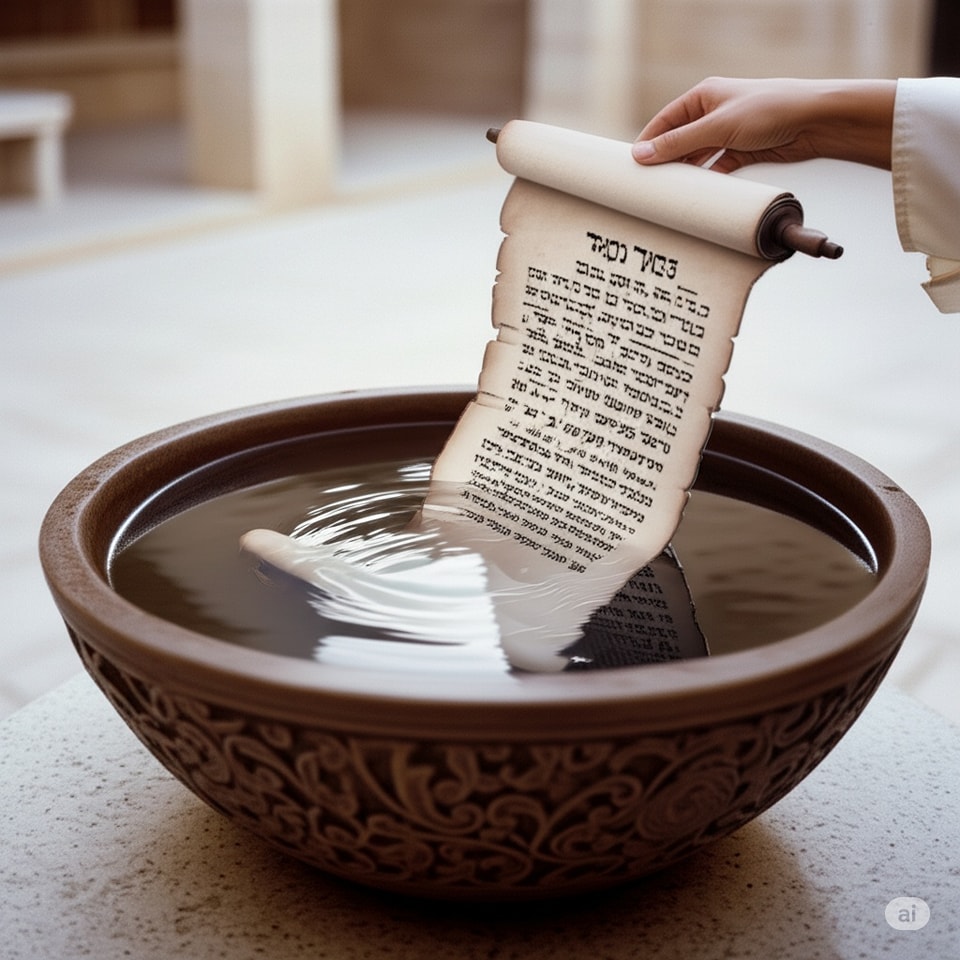
- Preparation of the Water: The priest mixes holy water with dust from the Tabernacle floor, writes curses on a scroll, and washes the ink into the water.
- Oath and Drinking: The woman is made to swear an oath. If she is guilty, the “bitter water” will cause her thigh to sag and her belly to distend (vv. 21, 27); if innocent, she will suffer no harm and remain fertile.
- Outcome: Divine intervention is expected to render visible consequences that correspond to her guilt or innocence.
Milgrom (1991) and Noth (1968) both emphasize the highly ritualized and theologically charged nature of this text. The involvement of sacred elements—Tabernacle dust, written curses, holy water—underscores the sanctity and gravity of the process.
4. Comparative Analysis: Ancient Near Eastern Parallels and Israelite Distinctions
4.1 Similarities
Several elements of the Sotah bear striking resemblance to the broader practice of water ordeals:
- Divine Arbitration: Both mechanisms rely on a deity (YHWH or river deities) to reveal hidden guilt through physical effects.
- Ritualized Procedure: Both involve formalized procedures conducted by religious or legal personnel.
- Use of Water: In both, water is central to the outcome, serving as the medium through which divine will is made manifest.
- Lack of Witnesses: Both operate in legal contexts where no human evidence is available, necessitating recourse to divine judgment.
4.2 Key Differences
Despite these similarities, the Sotah ritual diverges from Mesopotamian and Hittite ordeals in several crucial respects:
- Nature of the Water: In Mesopotamian ordeals, the river is the divine agent. In the Sotah, the water is not inherently divine but is ritualistically transformed through the addition of curses and sacred dust.
- Mechanism of Judgment: The Sotah focuses on internal physical symptoms (reproductive affliction), unlike the river ordeal’s external, often binary test of survival.
- Gender Specificity: The Sotah is exclusively applied to women suspected of adultery and initiated unilaterally by the husband. Near Eastern river ordeals could be employed in a broader range of cases and potentially included male participants or accusers as subjects.
- Outcome: The biblical ordeal, while potentially resulting in long-term harm, does not mandate death as an immediate consequence. In contrast, Mesopotamian ordeals might result in death by drowning, although this was not uniformly the case (Osumi, 2009).
- Theological Framing: The Sotah is embedded within Israel’s unique theological framework, with YHWH acting as a moral adjudicator in a sanctuary context. The ritual is thus not merely judicial but also covenantal in character.
5. Theological and Social Implications
The Sotah ritual reflects a theological innovation within a familiar cultural form. As Frymer-Kensky (1992) argues, the ritual represents an attempt to introduce controlled legal procedure into a domain typically governed by male jealousy, potentially curbing extrajudicial violence such as honor killings or lynching. In this way, the Israelite legal system transforms the ordeal into a formal, priestly process.
Scholars such as Milgrom (1991) and Osumi (2009) suggest that while the text is ethically problematic from a modern perspective, it reflects a broader concern in biblical law with maintaining social order and protecting individuals from arbitrary harm. The priestly involvement and procedural regularity stand in contrast to the possible volatility of private retribution.
6. Conclusion
The Sotah ritual in Numbers 5 stands as a unique adaptation of the ancient Near Eastern ordeal tradition. While drawing on shared cultural assumptions—especially the necessity of divine judgment in uncertain legal contexts—the biblical ritual reshapes these elements to fit Israel’s covenantal theology and legal practice. The comparison illuminates not only the cross-cultural continuities in legal thought but also the specific theological trajectories that distinguish biblical Israel within its ancient Near Eastern environment.
Bibliography
- Finkelstein, J. J. “The Ammurapi Code: Great ‘Revolution’ or ‘Evolution’?” Journal of the Ancient Near Eastern Society of Columbia University 1, no. 1 (1966): 1–22.
- Frymer-Kensky, Tikva. In the Wake of the Goddesses: Women, Culture, and the Biblical World. Free Press, 1992.
- Milgrom, Jacob. Numbers: The JPS Torah Commentary. Philadelphia: Jewish Publication Society, 1991.
- Noth, Martin. Numbers: A Commentary. Louisville: Westminster John Knox Press, 1968.
- Osumi, Y. “The Ordeal of the Jealousy Offering (Numbers 5:11–31) and Its Ancient Near Eastern Context.” Journal of Biblical Literature 128, no. 2 (2009): 263–278.
- Roth, Martha T. Law Collections from Mesopotamia and Asia Minor. Atlanta: Scholars Press, 1995.
- Van De Mieroop, Marc. A History of the Ancient Near East ca. 3000–323 BC. 2nd ed. Oxford: Blackwell Publishing, 2016.
- Walsh, Jerome T. Numbers: A Commentary. Grand Rapids: Eerdmans, 2001.
