Abstract:
Shavuot, one of the major Torah pilgrimage festivals, is unique in that the Torah does not assign it a specific calendar date. Instead, its observance is determined by counting seven weeks from the offering of the Omer, which marks the beginning of the barley harvest. This paper explores the agricultural foundations of Shavuot and examines how various Jewish sects, including the Pharisees and Sadducees, interpreted its timing. By analyzing historical, textual, and sociological perspectives, we argue that the original practice of determining Shavuot’s date was flexible and closely tied to the agricultural cycle, rather than fixed to a specific day of the week.
Introduction:
Shavuot, also known as the Festival of Weeks, is intrinsically linked to the agricultural cycle of ancient Israel. Unlike other major Jewish festivals, the Torah does not specify a calendar date for Shavuot. Instead, it instructs the counting of seven weeks from the day after the “Sabbath” when the Omer offering is presented (Leviticus 23:15-16). This ambiguity has led to varying interpretations regarding the commencement of the count and, consequently, the date of Shavuot.
In the Book of Exodus, the festival is first introduced as part of a tripartite pilgrimage cycle. Exodus 23:16 refers to it as חַג הַקָּצִיר (“the Feast of the Harvest”), a celebration of the first yield of the wheat harvest. This agricultural character is reinforced in Exodus 34:22, where it is called חַג שָׁבֻעוֹת (“the Feast of Weeks”), emphasizing the seven-week period between the beginning of the barley harvest and the conclusion of the wheat harvest. At this early stage, the festival is clearly rooted in the agrarian rhythms of ancient Israelite life and is tied to the offering of the first fruits, without reference to a specific date on the calendar (Wagenaar, 7-9).
The Book of Leviticus, particularly in chapter 23:15–21, shifts the focus toward ritual precision and cultic regulation. The text avoids using a specific name for the festival and instead describes it as occurring on the fiftieth day after the “day after the Sabbath” (מִמָּחֳרַת הַשַּׁבָּת) following Passover. The passage outlines detailed instructions for presenting new grain offerings, especially the two loaves of leavened bread (שְׁתֵּי הַלֶּחֶם) made from wheat. The emphasis is on the sacredness of time and the proper execution of Temple rites. This passage also becomes the basis for later halakhic disputes over how to calculate the date of Shavuot, which would become significant in sectarian debates between Pharisees, Sadducees, and later groups like the Qumran community.
In Deuteronomy 16:9–12, the festival is again referred to by name as חַג שָׁבֻעוֹת (“the Feast of Weeks”), but with an expanded ethical and social dimension. The people are instructed to count seven weeks “from the time the sickle is first put to the standing grain,” again connecting the timing of the festival to the agricultural cycle (Wagenaar, 58-73) .
Agricultural Foundations of Shavuot:
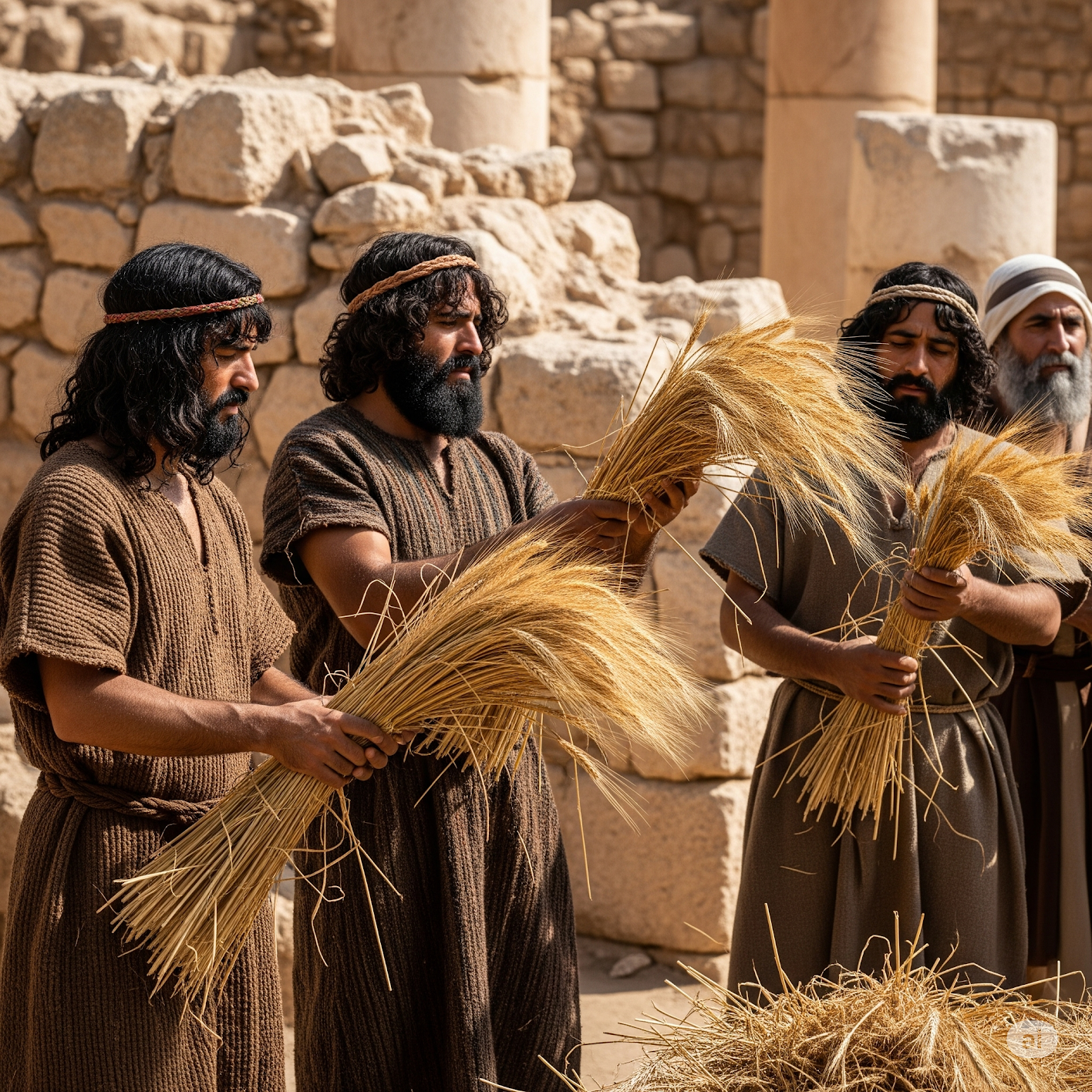
In its earliest biblical context, Shavuot (literally “Weeks”) functioned primarily as an agricultural festival marking the culmination of the grain harvest cycle in ancient Israel without a specified date due to the fact that harvest happens whenever the grain is ready (Knhol, 30). As described in Leviticus 23:15–21 and Deuteronomy 16:9–12, it celebrated the conclusion of the barley harvest—which began with the offering of the Omer during Passover—and the onset of the wheat harvest, particularly in the southern regions of Israel. The festival served as the endpoint of the seven-week counting period known as Sefirat HaOmer. This agricultural framework underscores Shavuot’s deep roots in the seasonal rhythms and subsistence practices of Israelite society.
Levin, in their commentaries on Leviticus reiterates that the Torah does not assign a fixed calendar date to Shavuot, referring to it instead as occurring “fifty days after the Sabbath” (Leviticus 23:16), This ambiguity, according to Milgrom, reflects the ancient agricultural reality: harvest timing was dependent on rainfall, climate, and geography, making a flexible reckoning more practical than a fixed date )Levin 312).
The Torah’s silence on a specific date may also reflect a tension between priestly and non-priestly calendar systems. It can be suggested that the Priestly source (P) sought to establish a standardized liturgical calendar centered around sacrificial offerings, while older traditions retained more fluid, seasonally sensitive practices.
Hoffmann, in his Commentary on Leviticus, also acknowledges the originally agricultural nature of the festival, yet he elaborates in detail why the meaning of Shabbat cannot be restricted solely to the weekly Sabbath. His argument is based on the opening verses of Leviticus 23, where Shabbat is included among the appointed festivals, thereby allowing the term Shabbat to be used not only to describe the weekly Sabbath but also to denote a festival or even a week—although he concedes that this is not the primary usage of the term. He also observes that the festivals are marked by a prohibition of labor, which by default classifies them as a form of Shabbat, comparable in function to the weekly Sabbath He further notes that the word שבתות (Shabbatot) in Leviticus 25:8 refers to entire years, each counted as the equivalent of a single day in the context of a festival cycle, rather than exclusively indicating the weekly Sabbath (Hoffmann, 141–142). This interpretation aligns with the phrase שבתות תמימות(“complete Sabbaths”), which cannot plausibly refer to individual Sabbath days—since how could a single day be counted as “complete” in the sense of a sequence? Thus, Hoffmann argues that the term Shabbat in this context must refer to a “week.” (Hoffmann, 146–148).
The Meaning of Shabbat in Leviticus
In the book of Leviticus, the word שבת (Shabbat) is used in the Priestly (P) source primarily in three ways, each reflecting a theological framework centered on rest, cessation, and sanctity.
First, שבת refers to the weekly seventh day, a day of complete rest. Leviticus 23:3 states that six days are for work, but the seventh is “שבת שבתון מקרא־קדש” — a Sabbath of complete rest and a holy convocation. This usage assumes the institution of a regular, cyclical cessation from labor, marking the seventh day as sanctified and distinct. It reflects the P source’s emphasis on order, ritual, and holiness in time, rooted in the divine pattern of creation.
Second, the term appears in the context of the Sabbatical Year, as seen in Leviticus 25:2–7. Here, the land itself is commanded to observe a “שבת ליהוה” — a Sabbath to YHWH. This seven-year agricultural cycle requires that the land lie fallow every seventh year, mirroring the human cycle of rest and reinforcing the idea that the land ultimately belongs to God. This “שבת הארץ” demonstrates that Sabbath is not just a human practice but extends to the rhythm of nature itself under divine sovereignty.
Third, Leviticus 25:8–12 describes the Jubilee Year, the fiftieth year following seven sabbatical cycles. While this year is named “יובל,” its characterization echoes Sabbath language, calling it again “שנת שבתון תהיה לכם.” The Jubilee involves release of land and persons, further expanding the concept of Sabbath beyond rest into a systemic reset of society based on divine justice. It is not just a cessation of labor, but a return to original ownership and freedom, grounded in the holiness and order God commands.
In all these instances, the word שבת in Leviticus functions as a theological and ritual principle of cessation, sanctification, and acknowledgment of divine authority. It is applied to time (the seventh day), space (the land), and society (in the Jubilee), always within a structured pattern of sevens that reflects the Priestly source’s concern for sacred order and regularity.
The LXX version of the Text
While the Masoretic and Samaritan versions of Leviticus 23:15–16 consistently use the term שַׁבָּת (shabbat)—typically understood as referring to the weekly Sabbath—the Septuagint (LXX) offers a notably different interpretive rendering:
ἀπὸ τῆς ἐπαύριον τῆς πρώτης ἡμέρας τοῦ σαββάτου… ἑπτὰ ἑβδομάδας ὁλοκλήρους ἔσονται… ἕως τῆς ἐπαύριον τῆς ἑβδόμης ἑβδομάδος
“From the morrow of the first day of the sabbath… seven full weeks shall be completed… until the morrow after the seventh week” – LXX Leviticus 23:15–16.
Although the term σαββάτου initially appears, subsequent references to שַׁבָּתוֹת in the Hebrew are translated as ἑβδομάδες (weeks) in Greek. This terminological shift appears to resolve the ambiguity present in the Hebrew text, aligning the LXX with the Pharisaic interpretation: the counting of the Omer begins on the day after the festival Sabbath (i.e., Nisan 16), rather than the day after the weekly Sabbath.
This interpretive translation implies that שַׁבָּת in Leviticus 23:15 does not necessarily refer to the literal seventh-day Sabbath, but can denote a unit of seven days—a week. This understanding finds support in Philo of Alexandria, who, in Special Laws (2.162), explicitly states that the Omer offering is brought “on the second day of the feast”—i.e., Nisan 16—without reference to the weekly Sabbath. Similarly, Josephus affirms this practice in Antiquities 3.250, describing the counting from the second day of Unleavened Bread.
Thus, the Septuagint reflects not only a translation choice but an interpretive stance, embedding within the Greek text a reading that privileges Pharisaic halakhah over Sadducean literalism. This reading further demonstrates the fluid semantic range of שַׁבָּת in Biblical Hebrew, which can occasionally extend to mean “week” (cf. Genesis 29:27–28).
Sectarian Interpretations
During the Second Temple period, differing interpretations emerged regarding the timing of the Omer count:
- Pharisaic Interpretation: The Pharisees, who emphasized the Oral Torah and rabbinic traditions, interpreted “Sabbath” in Leviticus 23:15 as referring to the first day of Passover (15 Nisan), a day of rest. Consequently, they began counting the Omer on 16 Nisan, leading to Shavuot falling on 6 Sivan. This interpretation became the basis for the fixed date observed in Rabbinic Judaism.
- Sadducean Interpretation: The Sadducees, associated with the priestly class and Temple rituals, understood “Sabbath” as the weekly Sabbath during the Passover week. Thus, they commenced the Omer count on the Sunday following that Sabbath, resulting in Shavuot always occurring on a Sunday. This interpretation aligns with a more literal reading of the text but introduces a fixed weekly pattern.
- Qumran Community: The sectarian group at Qumran, known from the Dead Sea Scrolls, adhered to a solar calendar and began the Omer count on the Sunday following Passover, with Shavuot consistently observed on a Sunday. Their calendar system reflects an attempt to standardize religious observances in alignment with their theological perspectives. This ambiguity led to divergent interpretations during the Second Temple period. The Book of Jubilees (ch. 6) insists that Shavuot must be celebrated on the 15th of Sivan and warns that those who follow a lunar-based calendar will miscalculate the sacred times. The Qumran community, which preserved this book and other calendrical texts such as 1 Enoch, adhered to a 364-day solar calendar and rigidly fixed Shavuot on the 15th of the third month. This sectarian calendar sought to restore what the group saw as the true divine order—one which the mainstream Jerusalem Temple had abandoned under Pharisaic influence.
Sociological Considerations:
The divergence in calendar interpretations among Jewish groups during the Second Temple period may not be fully explained by their sociological contexts. While the Pharisees are often portrayed as urban elites, their halakhic approach was notably dynamic and adaptable. This flexibility is evident in their oral traditions, which allowed interpretation of Torah law in varying social settings, including both rural and urban contexts (cf. Mishnah Sanhedrin 11:2). Their openness may have extended to calendrical issues as well, supporting a model that could accommodate both agricultural and communal-religious needs.
Conversely, the Sadducees—typically associated with the priestly aristocracy and Temple service—may have preferred amore fixed time for the day of the Omer making it always in the first day of the week to ensure stability and predictability. According to Josephus (Antiquities 13.297–298), the Sadducees adhered strictly to the written Torah, which may have led them to support a fixed system based on a literal interpretation of Leviticus 23. Their position, therefore, might have emphasized standardization for cultic accuracy, not agricultural variability (Regev, 83-90).
The Qumran community’s adoption of a rigid 364-day solar calendar (as found in texts such as 1 Enoch and the Book of Jubilees) can be interpreted not merely as a sectarian reaction against the Pharisees or Sadducees, but as an attempt to restore what they considered the divinely ordained order of time. For example, Jubilees 6:32–38 explicitly condemns the lunar calendar used by other Jews as leading to error in festival dates, which they viewed as a corruption of divine law. Thus, their calendar was less about isolation and more about reclaiming what they saw as a pure, pre-Exilic tradition(Verman, 6).
Joshua 5:11
This perspective coincides with the narrative in Joshua 5, particularly verses 10–12 in the MT. There, the Israelites celebrate the Passover on the evening of the 14th at Gilgal. Then, in verse 11, it states:
“וַיֹּאכְלוּ מֵעֲבוּר הָאָרֶץ מִמָּחֳרַת הַפֶּסַח מַצּוֹת וְקָלוּי בְּעֶצֶם הַיּוֹם הַזֶּה.”
“And they ate from the produce of the land on the morrow after the Passover, unleavened cakes and parched grain, on that very day.”
This has traditionally been understood as the 16th of Nisan—implying that they waited until the Omer offering was brought before eating from the new grain, as required in Leviticus 23:14. This would support the Pharisaic interpretation: that the Omer was waved immediately after the first day of the festival, even if it was not a Sunday. However, the simple meaning of the text is that it was the 15th day and that they might have brought the Omer on the first day of the feast(Ahituv, 107).
The language of Joshua 5:11 stands apart from the surrounding narrative in both style and content. Its emphasis on ritual precision—particularly the consumption of unleavened bread and parched grain “on that very day”—reflects a distinctly Priestly (P) concern, which is otherwise largely absent from the broader conquest narrative. This stylistic inconsistency strengthens the case for viewing the verse as a later Priestly insertion. Further evidence supporting this editorial theory lies in the redundancy between verses 11 and 12. Verse 12 reiterates the shift from manna to the produce of the land, a detail already conveyed in verse 11. Such repetition is a classic marker of textual editing in the Hebrew Bible, often signaling the attempt to integrate multiple traditions or to clarify an older narrative through the lens of later theological or ritual frameworks.
Joshua 5:11 is a late a gloss added to harmonize the narrative with the liturgical laws of Leviticus 23. The sudden shift in style, the use of terms like “עֲבוּר הָאָרֶץ” and “בְּעֶצֶם הַיּוֹם הַזֶּה”—both typical of Priestly language—support this theory. If verse 11 is removed, the flow from verse 10 (the Pesach offering) directly to verse 12 (the manna ceasing) is smooth and coherent:
Joshua 5:10: They celebrated the Pesach.
[verse 11 omitted]Joshua 5:12: The manna ceased the next day when they began eating from the land.
This continuity suggests that verse 11 may have been inserted to enforce the Levitical requirement not to eat of the new grain until the Omer is brought, presenting a retrojection of Priestly halakhah into earlier historical narrative.
Ironically, if one accepts the narrative without verse 11, it could imply that the Israelites ate from the new grain before bringing the Omer offering. Worse (from a P perspective), this might have occurred on a Sunday immediately after Pesach, aligning with Sadducean. This potential reading—one that hints at the Omer being brought on a Sunday after Pesach—would have been intolerable to the Priestly editor, who inserted verse 11 to clarify the point and bring the text in line with Leviticus 23. Therefore, even though there is no textual evidence (such as manuscript variants) that verse 11 is a later addition, the stylistic, linguistic, and ideological markers suggest that it may be. This editorial move reflects an intra-biblical polemic: an effort by the Priestly author or redactor to suppress earlier practices and solidify a liturgical calendar consistent with his theology.
The Septuagint (LXX) version of Joshua 5:11 notably omits the phrase “on the day after the Passover” found in the Masoretic Text (MT), instead stating simply that the Israelites ate unleavened bread and new grain that year. This omission removes a direct temporal link between the consumption of new grain and the Passover celebration, which the MT explicitly provides. The difference is significant because the MT’s phrasing appears to support the Pharisaic interpretation that the Omer offering occurs on the 16th of Nisan—“the day after the Passover.”
By contrast, the LXX’s version avoids specifying any link to the Passover, making the timing of the grain consumption more ambiguous (Rösel, 85-86). This textual variation weakens the narrative support for the fixed date interpretation found in later halakhic traditions and opens the possibility that the Greek translators either had a different Vorlage or intentionally modified the text to sidestep the calendrical debate reflected in Leviticus 23.
The Pharisees Interpretation
While the Pharisees rooted their understanding of the Omer count in the agricultural and festival-based language of Exodus 23:16 and Deuteronomy 16:9, they did not ignore Leviticus 23. Rather, they engaged in a process of harmonization, integrating all three legal traditions into a coherent halakhic framework. In Exodus and Deuteronomy, there is no fixed date for the offering of the first fruits or the beginning of the count; instead, the command is tied to the act of harvesting—“when the sickle is first put to the standing grain.” This gave the impression of flexibility and situational timing, rather than a date anchored to the weekly Sabbath.
However, Leviticus 23 introduces a more rigid cultic structure. It specifies that the Omer is to be waved “מִמָּחֳרַת הַשַּׁבָּת” (“on the morrow after the Sabbath”), a phrase that became the focal point of interpretive debate. The Sadducees, as stated above, read this phrase literally as referring to the weekly Sabbath, thus fixing the Omer to Sunday. But the Pharisees, committed to maintaining fidelity to all three Torah traditions, reinterpreted the term “Sabbath” in Leviticus 23 to mean the first day of Chag HaMatzot, which is itself a Sabbath-like festival (cf. Leviticus 23:7).
This interpretive move was not arbitrary—it reflects a deeper hermeneutical strategy that prioritized consistency across the Torah’s various legal corpora. For the Pharisees, the legal system could not allow Leviticus to undermine Exodus and Deuteronomy, nor could Exodus and Deuteronomy be seen as undermining the festival calendar of Leviticus. Thus, they developed an exegetical resolution: the cutting of the grain and the waving of the Omer would always take place on the 16th of Nisan, the day after the first festival day of Matzot, aligning the ritual timing with both the agricultural flow of Deuteronomy and the cultic regulation of Leviticus.
The Pharisaic position—later codified in Rabbinic tradition—held that “the Sabbath” referred not to the weekly Sabbath but to the first day of Chag HaMatzot (the Festival of Unleavened Bread), which is itself a Yom Tov (a type of Sabbath). According to this view, the Omer offering was brought on the 16th of Nisan, immediately after the first day of the festival, regardless of the weekday.
This understanding finds support in Deuteronomy 16:9, which instructs to begin the count “from the time the sickle is first put to the standing grain” (מֵהֵחֵל חֶרְמֵשׁ בַּקָּמָה). Neither in Deuteronomy nor in Exodus is a specific date given for the Omer; instead, the beginning of the count is agricultural in nature. This may indicate that the Pharisees understood the starting point to be situational and ritual—when the grain is ripe and the festival has begun—not calendrical. The “day” becomes secondary to the act of cutting the grain and making the offering.
We must also take into consideration Hoffmann’s argument that there is a textual anomaly in which the term Shabbat is not used exclusively to denote the weekly Sabbath. The plural form, combined with the genitive adjective “complete” (שבתות תמימות), raises important questions and was likely a component of the Pharisaic interpretation. The requirement to wait a full seven-day period may also explain why the Boethusians and the Qumran calendar tradition postponed the celebration of Shavuot until the end of the festival week—they too sought to ensure that an entire week had passed. However, as evidenced by the Qumran calendar, this system requires deliberate manipulation to ensure that the festival begins on a Sunday so that Shavuot also falls on a Sunday.
In this light, the Pharisaic position represents not just a polemical stance against Sadducean literalism, but a sophisticated example of intertextual harmonization—a method that reconciles legal differences by interpreting ambiguities in one text (e.g., “Sabbath” in Leviticus) through the lens of others (e.g., “when the sickle is first put to the standing grain” in Deuteronomy). This approach allowed them to maintain halakhic coherence across the Torah and laid the groundwork for later rabbinic hermeneutics.
Final Thoughts
The absence of a specific calendar date for Shavuot in the Torah suggests an original practice deeply connected to the agricultural rhythms of ancient Israel. The festival’s timing was likely flexible, determined by the onset of the harvest rather than a fixed day of the week. The later sectarian debates and interpretations represent efforts to standardize religious observance within diverse communities. Recognizing the agricultural origins of Shavuot provides anunderstanding of the evolution of Torah observance in an ever changing society trying to understand the ancient practices of an agricultural society controlled by city dwelling and/or philosophical sectarian movements which struggled for supremacy over the temple and Torah.
The biblical term שָׁבוּעַ (shavua, “week”) appears prominently in the legal instructions concerning the Feast of Weeks (Shavuot) in the books of Exodus and Deuteronomy. These texts emphasize the requirement to count seven shavuot from the time of the barley harvest, leading up to the celebration of the festival. The formulation of this requirement, particularly in Deuteronomy 16:9–10 and Exodus 34:22, suggests that the original conceptualization of shavuot reflects an agricultural and procedural concern with the counting of discrete seven-day periods, rather than a calendrical structure tied to the fixed weekly cycle beginning on Sunday and ending on Saturday.
Deuteronomy 16:9 states: שִׁבְעָה שָׁבוּעוֹת תִּסְפָּר-לָךְ מֵהָחֵל חֶרְמֵשׁ בַּקָּמָה תָּחֵל לִסְפֹּר שִׁבְעָה שָׁבוּעוֹת (“You shall count seven weeks; from when the sickle is first put to the standing grain you shall begin to count seven weeks”). The focus of this verse is the act of counting from an agricultural event—namely, the beginning of the grain harvest—rather than a fixed calendar date. The use of the verb תָּחֵל (“you shall begin”) tied to the commencement of harvesting implies that the start of the count may vary from year to year. This framing stands in contrast to the view, held by groups such as the Boethusians and Qumran sectarians, that the count must always begin on a Sunday in order to fix Shavuot on a Sunday seven weeks later.
In the Priestly (P) source, particularly in Genesis 1, the structured presentation of a seven-day creation narrative—beginning with yom echad (“Day One”) and culminating in the yom ha-shevii (“seventh day” or Sabbath)—establishes a conceptual framework for the seven-day week that underlies the later Sunday-to-Saturday cycle. This literary structure assigns theological and cosmic significance to the sequence and rhythm of days, with the Sabbath serving as the climax and sanctified conclusion of the cycle.
Nevertheless, it is possible to argue that the term שָׁבוּעַ (shavua, “week”) originally referred more broadly to a unit of seven consecutive days, rather than to a fixed calendrical cycle beginning on Sunday. This interpretation is supported by legal and cultic contexts, including within Priestly texts themselves, where durations are expressed as periods of seven days without reference to specific weekdays. For example, in Leviticus 12:5, the impurity of a woman following childbirth is measured in units of “seven days” (shivat yamim) or multiples thereof. These durations are counted from the event of birth rather than aligned with the Sabbath or a fixed weekly cycle.
Although the Priestly source typically uses expressions such as שִׁבְעַת יָמִים (“seven days”) rather than the noun שָׁבוּעַ, this does not contradict the understanding of the week as a heptadic unit. Rather, it may reflects the lexical preferences of the Priestly tradition, in which the term shavua is rare or absent. The use of shavua in connection with the Feast of Weeks (Chag HaShavuot)—a term appearing in non-Priestly traditions such as Exodus 34:22 and Deuteronomy 16:9–10—likely reflects the incorporation of an older terminological layer into the Priestly framework, rather than an innovation of P itself.
Therefore, even within the Priestly source, a shavua or seven-day unit can be understood as a full sequence of days counted forward from a specific event, irrespective of the conventional weekly structure. This flexible usage suggests that the concept of a “week” in biblical literature is not always uniformly defined by a fixed calendar cycle, but rather can refer to any complete sequence of seven days, particularly in cultic or legal contexts.
Further clarification is provided by Leviticus 23:15–16, where the count toward Shavuot is framed in terms of שֶׁבַע שַׁבָּתוֹת תְּמִימֹת (“seven complete sabbaths” or “seven complete weeks”). Although the term שבתות in this context may appear to suggest literal Sabbaths (i.e., Saturdays), the qualifier תמימות (“complete”) more likely refers to full seven-day periods. This reading aligns with traditional Rabbinic interpretation, which views the term שבתות in this passage as synonymous with שבועות, emphasizing completeness rather than calendrical alignment. Targumic renderings and early exegetical traditions support this interpretation, translating שבתות in Leviticus 23 in terms consistent with “weeks” rather than literal Sabbaths.
The distinction between the Priestly conception of the Sabbath as a fixed seventh day (evident in Genesis 1 and Exodus 20) and the Deuteronomic focus on counting שבועות from the time of harvest illustrates differing calendrical and liturgical orientations within the biblical corpus. The Priestly tradition emphasizes cosmic regularity and structured sacred time, while Deuteronomic and other non-Priestly texts reflect a temporality responsive to agricultural cycles and human action. Accordingly, the use of שבועות in Exodus and Deuteronomy underscores the process of counting seven-day units, without requiring that these units begin on a specific day of the week.
In sum, the textual and linguistic evidence suggests that the biblical injunction to count שבעה שבועות toward the Feast of Weeks is rooted in a conception of time based on agricultural activity and the completion of full seven-day periods. The sources do not require that the count begin on a Sunday or conform to a fixed weekly structure. Rather, the focus lies in the sequential counting of full heptads, independent of the standardized Sunday-to-Saturday week found in Priestly texts. This interpretation reflects a broader and more flexible understanding of sacred time in the pre-exilic tradition.
Bibliography
Knohl, Israel. The Sanctuary of Silence: The Priestly Torah and the Holiness School. Minneapolis: Fortress Press, 1995.
Levine Baruch A., The JPS Torah Commentary: Leviticus, Philadelphia, 1989.
Rösel Hartmut N. Historical Commentary on the Old Testament Joshua, Leuven, 2011.
אחיטוב שמואל, מקרא לישראל יהושע, ירושלים 1995.
דניאל-נטף סוזן, כתבי פילון כרך שלישי, ירושלים 2000.
ורמן כנה, ספר היובלים מבוא תרגום ופרוש, ירושלים 2015.
פראן מאיר, דרכי הסגנון הכהני בתורה דגמים, שימושי לשון, מבנים, ירושלים 1989.
רגב איל, הצדוקים והילכתם, ירושלים 2005.
רד״צ הופמן, ספר ויקרא, ירושלים תשי״ד.
Other Suggested sources
Baumgarten, Joseph M. The Flourishing of Jewish Sects in the Maccabean Era: An Interpretation. Leiden: Brill, 1997.
Milgrom, Milgrom. Leviticus 23–27 (Anchor Yale Bible), 1993–1995.
Noth, Martin. Leviticus: A Commentary. Old Testament Library, 1965.
