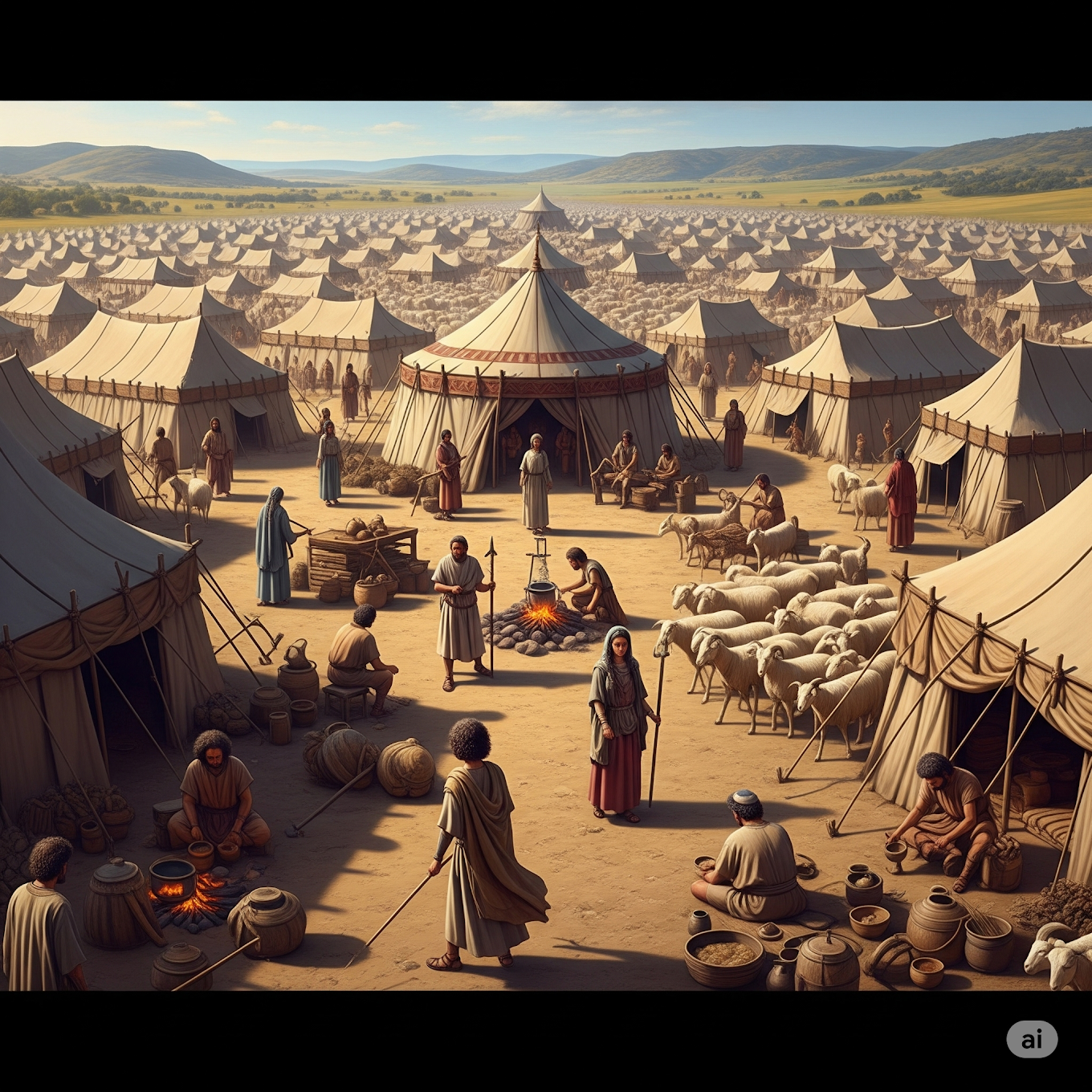
The injunction against the direct enumeration of individuals in Judaism, particularly concerning the Israelite people, constitutes a significant halakhic (Jewish legal) and theological principle. This prohibition, deeply rooted in biblical narrative and extensively elaborated upon by rabbinic exegesis, reflects complex concerns regarding divine providence, human vulnerability, and the sanctity of the individual.
I. Scriptural Foundations
The primary biblical source for this prohibition is found in Exodus 30:11-13, concerning the census commanded by God to Moses. Here, rather than a direct headcount, each Israelite male aged twenty years or older was required to contribute a half-shekel as an “atonement for his soul” (kōper nafshō). The text explicitly states, “when you number them for their enrollment, then each shall give a ransom for his soul to the Lord, when you number them, that there be no plague among them when you number them.” Medieval commentators, such as Rashi (Rabbi Shlomo Yitzchaki), interpret this passage to signify that a direct enumeration is inherently perilous, potentially inviting divine judgment or the “evil eye” (Heb. Ayin Hara), thus necessitating the indirect method of counting through the half-shekel. The payment serves as a surrogate, a tangible representation of the individual that diverts the negative consequences associated with direct tabulation.
A corroborating, albeit cautionary, narrative is found in 2 Samuel 24, detailing King David’s unauthorised census of Israel and Judah. Despite the warnings of Joab, his commander, David proceeds with the count. The direct consequence of this act is a devastating plague that claims 70,000 lives. This episode is widely understood within Jewish tradition as a punitive response to David’s transgression of the implicit prohibition against direct counting, underscoring the severe repercussions of such an act.
Furthermore, the prophetic utterance in Hosea 2:1 (MT 2:1) states, “And the number of the children of Israel shall be as the sand of the sea, which shall neither be measured nor counted.” This verse is often cited as a testament to the divinely ordained innumerability of the Jewish people, suggesting that their true magnitude transcends human quantification and is subject solely to divine knowledge and blessing.
II. Theological and Philosophical Underpinnings
The prohibition against counting is predicated on several interconnected theological and philosophical premises:
Protection from the Ayin Hara (Evil Eye): This is perhaps the most prevalent explanation. Direct enumeration is perceived as rendering individuals vulnerable to negative spiritual influences or excessive divine scrutiny. When a group is precisely quantified, it becomes susceptible to scrutiny and potential judgment, which, if found lacking, could manifest as misfortune or plague. The indirect method, by contrast, obfuscates the exact number, thereby offering a degree of spiritual protection.
Emphasis on Divine Providence: The prohibition underscores that the strength, security, and prosperity of the Jewish people are not contingent upon their numerical size but rather upon their steadfast relationship with and dependence on God. To rely on numerical superiority would imply a lack of faith in divine protection and an overestimation of human agency. This aligns with the biblical motif that “not by might, nor by power, but by My spirit” (Zechariah 4:6) is success achieved.
Affirmation of Individual Worth: Some interpretations suggest that direct counting can reduce individuals to mere statistics, thereby diminishing their unique inherent value. Judaism places a strong emphasis on the sanctity and distinctiveness of each person. The indirect method, such as the half-shekel contribution, transforms the act of “counting” into a communal expression of individual contribution and interconnectedness, rather than a depersonalising tally.
Humility and Avoiding Arrogance: Excessive pride or self-importance derived from large numbers is viewed as antithetical to Jewish values. The prohibition fosters a sense of humility and recognition that all blessings, including numerical strength, emanate from a divine source.
The Concept of “Preciousness”: Analogous to valuable possessions that are not openly displayed or meticulously counted for fear of loss or envy, the Jewish people are considered precious to God. Their precise number is thus kept somewhat indeterminate to maintain this esteemed status and safeguard them from adverse spiritual forces.
III. Permissible Methods of Ascertainment
Despite the prohibition, practical necessities, particularly for the performance of mitzvot (commandments), occasionally require an approximate understanding of group size. In such instances, rabbinic tradition has sanctioned indirect methods:
Counting through Surrogate Objects: The most common method involves counting an equivalent number of inanimate objects (e.g., coins, pebbles, or even an individual’s fingers) that represent each person. This echoes the biblical precedent of the half-shekel.
Counting by Thought or Scriptural Passages: For purposes like forming a minyan (a quorum of ten adult males required for communal prayer), individuals may silently count in their minds. Alternatively, a passage from Scripture containing precisely ten words, such as “Hoshia et Amecha u’varech et Nachalatecha u’reim ve’naseim ad HaOlam” (Psalms 28:9), can be recited, with each word corresponding to a person.
Counting for a Mitzvah (Commandment): While general counting is forbidden, it is permitted, and even encouraged, to “count” when it is directly related to the performance of a mitzvah. For instance, counting the Omer (a ritual counting of days between Passover and Shavuot) is explicitly commanded.
Conclusion
In conclusion, the prohibition of counting people in Judaism is a multifaceted doctrine that extends beyond a simple numerical taboo. It embodies profound theological principles concerning divine sovereignty, the inherent value of the individual, the perils of the “evil eye,” and the importance of humility, thereby shaping a distinctive approach to communal identity and spiritual well-being within Jewish thought and practice.
Bibliography
Berlin, M. (2007). The Evil Eye: Its Origins and Practices. Jason Aronson.
Hirsch, S. R. (1989). The Pentateuch: Exodus. Feldheim Publishers. (Original work published 1867-1878)
Kaplan, A. (1993). Handbook of Jewish Thought. Moznaim Publishing Corporation.
Sacks, J. (2009). Covenant & Conversation: Exodus, The Book of Redemption. Maggid Books.
Steinsaltz, A. (2001). The Essential Talmud. Basic Books.
