Abstract
Ezra chapter one presents a striking proclamation attributed to Cyrus the Great, king of Persia, authorising the Jewish exiles to return to Jerusalem and rebuild the Temple of YHWH. This declaration, central to the narrative of the post-exilic return, raises significant historical and philological questions regarding its composition, ideological function, and relationship to external historical sources. This paper critically examines the portrayal of Cyrus in Ezra 1 against the backdrop of the Cyrus Cylinder, an authentic Achaemenid inscription. By analysing the language, theological framing, and historical context of both texts, this study argues that the Ezra declaration, while not a verbatim transcription of an imperial edict, represents a theologically oriented adaptation of a genuine Persian imperial policy. It highlights the nuanced interplay between Persian imperial pragmatism and Judean religious particularism, demonstrating how historical events were absorbed, localised, and reinterpreted within the sacred history of ancient Yehud.
Keywords: Cyrus Cylinder, Ezra, Achaemenid Empire, Second Temple Period, Historical Criticism, Literary Criticism, Persian Policy, Judean Identity.
1. Introduction: The Proclamation of Cyrus in Ezra
Ezra chapter one opens with a pivotal moment in biblical history: a decree from Cyrus II, the founder of the Achaemenid Persian Empire, permitting the Jewish exiles to return to their homeland and rebuild the Temple in Jerusalem. The text states:
“Thus said Cyrus king of Persia: All the kingdoms of the earth has YHWH, the God of Heaven, given to me; and He has charged me to build Him a house in Jerusalem, which is in Judah.” (Ezra 1:2)
This declaration serves as the foundational impetus for the return from Babylonian exile and the subsequent reconstruction of the Temple, events of profound significance for the nascent Judean community. However, the unique phrasing and theological claims embedded within this opening statement immediately invite scholarly scrutiny. Questions regarding the language of the proclamation, the portrayal of Cyrus’s relationship with YHWH, and the overall historicity of the decree are central to understanding the complex interplay between historical memory, imperial policy, and theological narrative in the Hebrew Bible. This paper will address these questions, employing a critical comparative methodology, particularly focusing on the archaeological evidence provided by the Cyrus Cylinder.
2. The Language of the Proclamation
One of the most immediate scholarly concerns regarding the decree in Ezra 1 is its language. The biblical text presents the proclamation in Hebrew, despite the fact that the Achaemenid administration primarily utilised Imperial Aramaic for official correspondence across its Western satrapies, and Akkadian for inscriptions within the Babylonian heartland (Grabbe, 2006, pp. 28-30). This linguistic discrepancy has led some scholars, notably those associated with the Copenhagen School such as Philip R. Davies (1992), to argue that the so-called Cyrus Declaration in Ezra is not a verbatim translation of an actual imperial decree. Instead, they propose it is a Judean literary construct, retrojecting a theological interpretation onto a broader historical reality, serving to legitimise post-exilic Judean claims and religious identity.
However, the choice of Hebrew need not necessarily imply a deceptive fabrication. Rather, it can be understood as a reflection of ancient administrative practice, where imperial policies were often rendered into vernacular idioms for the consumption of local audiences. It is highly plausible that the author of Ezra, writing from a Judean perspective and for a Judean audience, adapted the imperial message into the language and theological worldview of his own people. As Lester Grabbe (2006) and others have observed, it was a common policy under Cyrus to accommodate local religious traditions, and this often entailed issuing or supporting proclamations in the relevant local languages. Furthermore, the existence of an Aramaic version of the decree in Ezra 6:3-5, retrieved from the archives at Ecbatana, suggests that such documents did exist in the imperial chancery’s administrative language. The Hebrew version in Ezra 1 might therefore be a summary or a popularised adaptation for the Judean community, designed for religious and motivational purposes, rather than a bureaucratic record.
3. Cyrus and the God of Israel
The assertion that Cyrus received his authority from “YHWH, the God of Heaven” (YHWH Elohei ha-Shamayim) in Ezra 1:2 aligns intriguingly with the ideology presented in the Cyrus Cylinder. This significant Babylonian cuneiform inscription, discovered in the 19th century, portrays Cyrus attributing his victory over Babylon to the chief Babylonian deity, Marduk, who supposedly appointed him to restore justice, free oppressed peoples, and return sacred images to their rightful temples. The parallel with Ezra’s depiction is evident: both portray Cyrus as a divinely appointed ruler and a restorer of cults and peoples.
Yet, the crucial difference lies in the monotheistic reworking found in Ezra. Whereas the Cyrus Cylinder reflects a broadly polytheistic Mesopotamian worldview, where Cyrus acts under the auspices of Marduk and various other local deities, the biblical version filters this through a distinctly monotheistic lens. It presents Cyrus as an agent of YHWH alone, universalising YHWH’s authority by terming Him “the God of Heaven” (Elohei ha-Shamayim). This title was highly significant in the Persian period, offering a universalising aspect of YHWH that could resonate with Persian imperial theology (which also acknowledged a supreme heavenly deity, Ahura Mazda), thereby making YHWH more palatable to the Persian administration while maintaining distinctiveness for the Judeans.
Simultaneously, the phrase “the God who is in Jerusalem” (Ezra 1:3) reflects a strategic localisation. While acknowledging Cyrus’s broader policy of religious restoration, the biblical author frames this within the theological confines of Israelite religion, where YHWH is uniquely associated with this people in this city and, crucially, this Temple. Some critics have interpreted this localised phrasing as evidence of religious relativism or theological compromise, suggesting YHWH is presented as merely a local deity among many. However, within the context of Second Temple theology, it more likely reflects a pragmatic acknowledgement of the imperial milieu while simultaneously reinforcing Jerusalem’s unique cultic status and YHWH’s covenantal dwelling there. This dual emphasis on YHWH as both the universal “God of Heaven” and the particular “God who is in Jerusalem” highlights a sophisticated theological perspective navigating both imperial and national religious identities.
4. The Historicity of the Proclamation
Skepticism about the proclamation’s authenticity has a long pedigree. Scholars such as Thomas L. Thompson and Philip R. Davies, associated with the minimalist Copenhagen School, have suggested that the declaration in Ezra was largely a post-exilic invention designed to legitimise Judean claims to the land and the reconstructed Temple (Davies, 1992). From this perspective, which generally views biblical narratives as later literary constructions with minimal direct historical correlation, the portrayal of Cyrus as a divine agent functions primarily as ideological reinforcement rather than historical reportage.
However, archaeological parallels, most notably the Cyrus Cylinder, significantly complicate this purely minimalist view. The Cylinder records Cyrus’s policy of restoring various sanctuaries and returning deported peoples to their homelands—policies that are remarkably consistent with the biblical narrative concerning the Jews. While Ezra’s formulation is undoubtedly shaped by Judean theological concerns and is not a verbatim copy, it cannot be dismissed as mere fiction. Instead, it appears to be a localised and theological adaptation of a genuine imperial policy (Kuhrt, 1983; Grabbe, 2006).
Further textual complexity arises from Ezra 6:3–5, where a separate version of the decree is presented, this time in Aramaic, complete with specific architectural dimensions and materials for the Temple. The duplication and differing details have raised questions about whether two decrees were issued, or whether one version is a literary embellishment. A plausible explanation, consistent with ancient administrative practice, is that Ezra 1 preserves a public proclamation or a simplified, religiously framed version directed towards the Judean population, perhaps orally disseminated or summarised, while Ezra 6 contains a more bureaucratic memorandum retrieved from imperial archives in Ecbatana (cf. Ezra 6:2). Imperial proclamations often existed in multiple formats for different audiences and administrative purposes (Briant, 2002, pp. 50-51).
5. The Cyrus Cylinder: Discovery, Content, and Comparative Analysis
To fully appreciate the nuanced historicity of the Ezra proclamation, a detailed examination of the Cyrus Cylinder is essential.
5.1. Discovery and Provenance
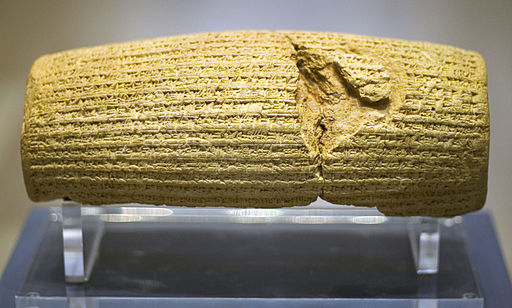
The Cyrus Cylinder was discovered in 1879 during excavations conducted by Hormuzd Rassam at the site of ancient Babylon, under the auspices of the British Museum. This barrel-shaped clay cylinder, inscribed in Akkadian cuneiform, dates to c. 539–530 BCE, immediately following Cyrus II’s conquest of Babylon. It was part of a foundation deposit buried in the city wall of Babylon, a typical placement for royal inscriptions intended to immortalise the king’s achievements and legitimise his rule.
The Cylinder’s content is widely interpreted as a royal declaration within the established tradition of Mesopotamian royal inscriptions, portraying Cyrus as a legitimate and divinely chosen ruler who restored justice and order after the perceived misrule of Nabonidus, the last Neo-Babylonian king. Importantly, the Cylinder is not a general imperial decree intended for the entire empire but a specific, local inscription composed for the Babylonian elite. It is steeped in Babylonian religious and political idiom, designed to win the favour of the powerful Marduk priesthood and the populace. However, its underlying principles and policies—of religious toleration and restoration—reflect broader Achaemenid patterns of rulership.
5.2. Key Excerpts: Transliteration and Translation
The following section provides a simplified transliteration and English translation of key lines from the Cyrus Cylinder (approximately lines 20–30), which are most pertinent to a comparison with the Ezra narrative. The transliteration is simplified for readability, omitting some diacritical marks used in full philological transliterations of Akkadian, a Semitic language.
Akkadian Transliteration (simplified):
…ištu eššû ul iṭrudū, šu-ú ana ḫaṭṭišu iqabbû
…ilānū ša mītūtišunu ana maḫāzīšunu ušērib
…mārē mātāti ša Nabû-naʾid ana qabal mātāti etelû
…ilānū ša ina qabal mātāti ištēnū ušērib ina mātātišunu
…ubbil ilānū ana ēkalšun
English Translation (adapted from Kuhrt, 1983 and British Museum):
“…from [the beginning] until now, the [sacred images] which had been taken to Babylon, I returned to their places and made them dwell in eternal abodes.
I gathered all their people and returned them to their settlements.
The gods who had dwelt there I restored to their sanctuaries, and I let them dwell in residences pleasing to their hearts.
May all the gods whom I brought back pray daily before Bēl and Nabû for long life for me.”
5.3. Key Elements of the Cylinder’s Ideology
From these and related lines, several key themes emerge in Cyrus’s imperial ideology:
Divine Authorization: Cyrus explicitly states that Marduk, the chief Babylonian god, chose him due to Nabonidus’s alleged impieties and neglect of cultic duties. This legitimises Cyrus’s conquest as a divinely sanctioned act of liberation and restoration, not mere aggression.
Restoration: Cyrus portrays himself as a benevolent restorer—of temples, of divine order, and of proper worship, portraying his rule as bringing stability and prosperity.
Religious Pluralism: He claims to have returned various deities and their cult images to their rightful sanctuaries, and to have allowed displaced populations to return to their homelands. This policy demonstrates a strategic religious tolerance.
Imperial Strategy: This approach of religious accommodation and population resettlement served as a crucial means of securing loyalty from diverse subject peoples, integrating them into the newly formed empire, and legitimising his rule across various cultural and religious contexts (Rollinger, 2001).
5.4. Comparative Analysis: Cyrus Cylinder vs. Ezra 1
A direct comparison between the Cyrus Cylinder and Ezra 1 reveals striking similarities in underlying policy alongside significant differences in theological framing and audience targeting.
Hebrew Text (Ezra 1:2-4):
כֹּה אָמַר כֹּרֶשׁ מֶלֶךְ פָּרַס:
כָּל מַמְלְכוֹת הָאָרֶץ נָתַן לִי יְהוָה אֱלֹהֵי הַשָּׁמַיִם,
וְהוּא פָקַד עָלַי לִבְנוֹת לוֹ בַּיִת בִּירוּשָׁלִַם אֲשֶׁר בִּיהוּדָה.
מִי בָכֶם מִכָּל עַמּוֹ יְהִי אֱלֹהָיו עִמּוֹ,
וְיַעַל לִירוּשָׁלִַם אֲשֶׁר בִּיהוּדָה,
וְיִבֶן אֶת בֵּית יְהוָה אֱלֹהֵי יִשְׂרָאֵל – הוּא הָאֱלֹהִים – אֲשֶׁר בִּירוּשָׁלִָם.
Transliteration of Hebrew (Ezra 1:2-4):
Koh amar Koresh melekh Paras:
Kol mamlekhot ha’aretz natan li YHWH Elohei haShamayim,
v’hu fakad alai livnot lo bayit biYerushalaim asher biYehudah.
Mi bakhem mi-kol ammo yehi Elohav immo,
v’ya’al liYerushalaim asher biYehudah,
v’yiven et beit YHWH Elohei Yisrael – hu haElohim – asher biYerushalaim.
English Translation (Ezra 1:2-4):
“Thus said Cyrus, king of Persia:
All the kingdoms of the earth has YHWH, the God of Heaven, given to me,
and He has charged me to build Him a house in Jerusalem, which is in Judah.
Whoever among you of all His people—may his God be with him—
let him go up to Jerusalem in Judah and build the house of YHWH, the God of Israel—He is the God who is in Jerusalem.”
| Theme | Cyrus Cylinder | Ezra 1 |
|—|—|—|
| Divine sanction | Marduk (and other local gods) gives kingship to Cyrus | YHWH, the God of Heaven, gives all kingdoms to Cyrus |
| Restoration of cults | Returns gods/images and peoples to their sanctuaries | Commands rebuilding of the Temple in Jerusalem; return of cultic vessels |
| Scope of policy | Mentions many gods, cities, and peoples across Babylon | Focuses exclusively on YHWH and the Jewish people |
| Text language | Akkadian (for local Babylonian audience) | Hebrew (for Judean audience) |
| Theological basis | Polytheistic, imperial legitimacy through local deities | Monotheistic, theological exceptionalism, divine providence |
| Primary Audience | Babylonian elite and local populace | Returning Judean exiles and broader Judean community |
Key Observations from Comparison:
Adaptation of Imperial Rhetoric: Ezra’s version clearly adapts Cyrus’s general imperial policy to a specific Judean religious framework. Rather than Marduk commissioning Cyrus, it is YHWH, emphasizing YHWH’s divine universality (“God of Heaven”) but also particularisation (“who is in Jerusalem”). This highlights the biblical author’s reinterpretation of a common imperial decree for a particular faith community.
Localized Theological Framing: The phrase “He is the God who is in Jerusalem” (Ezra 1:3), while aligning with the ancient Near Eastern practice of associating gods with cities, within Second Temple Judaism affirms both YHWH’s supreme status and His unique covenantal dwelling in Jerusalem. This demonstrates a sophisticated theological manoeuvre: acknowledging the imperial context while reinforcing national religious identity.
Ethnocentric Retelling: The biblical author, likely drawing on authentic imperial authorisation or summaries of Persian policy, reworks it through a distinct theological lens. This results in a nationalistic and religiously centered narrative of the restoration, providing a powerful foundational story for the returning exiles.
Not Verbatim, but Resonant: Crucially, the biblical declaration in Ezra 1 is not a literal, word-for-word translation of the Cyrus Cylinder or any other known imperial decree. However, it is profoundly consistent in its core themes of religious restoration, the return of deported peoples, and the divine endorsement of Cyrus’s rule. This thematic resonance strongly suggests a basis in genuine Persian policy, which was then rearticulated and theologised for the specific religious and cultural context of the Judean returnees.
6. What We Learn from the Comparison
The comparative analysis between the Cyrus Cylinder and Ezra 1 offers a nuanced understanding of the historical and literary dynamics at play. The Ezra proclamation should not be dismissed as mere fiction or pure theological propaganda. Instead, it reflects historical policies genuinely initiated by Cyrus, albeit thoroughly reinterpreted and reframed for a specific religious community and its distinct theological needs. The writer of Ezra did not invent the idea of restoration; rather, he infused a known imperial action with profound theological significance for the Judean people.
This comparison highlights a fundamental distinction between:
Persian Pragmatism: Cyrus’s primary goal was imperial cohesion and stability, achieved through a strategic policy of religious accommodation and restoration. This fostered goodwill among conquered peoples and facilitated their integration into the empire.
Judean Particularism: The Judean author’s goal was to affirm divine providence, the legitimacy of the return to Judah, and the singular centrality of the Jerusalem Temple. These events are thus presented as firmly within YHWH’s sovereign plan for His covenant people.
These two distinct aims overlap significantly regarding the action of return and rebuilding, but diverge dramatically in their interpretation of causality and divine motivation. The biblical text in Ezra thus functions less as a strict legal edict and more as a theological narrative—placing divine restoration at the centre of history and providing a powerful foundational story for the nascent Second Temple community, designed to inspire faith and legitimise the arduous task of rebuilding.
7. Conclusion: Critical Reflections on Historicity and Literary Adaptation
The narrative in Ezra chapter one is best understood as a theologically oriented adaptation of an authentic imperial policy. While the precise words of Cyrus as recorded in Ezra are unlikely to be verbatim, the core historical claim—that Cyrus authorised the rebuilding of the Jerusalem Temple and the return of exiles—is demonstrably consistent with what we know of Achaemenid policy from external sources, particularly the Cyrus Cylinder.
It is imperative to resist both extremes: dismissing the biblical account as pure fiction or accepting it uncritically as a literal, unmediated historical record. A critical, historical reading allows for a nuanced appreciation of how ancient Judean authors incorporated, reshaped, and theologised imperial actions within their own distinct cultural and religious framework. The biblical author engaged in a process of reinterpretation, taking a historical event and imbuing it with profound theological meaning, showcasing YHWH’s sovereignty over world empires and His faithfulness to His people.
As historians and biblical scholars, we must maintain methodological caution and recognise that texts such as Ezra are not transparent windows into the past, but rather refracted images shaped by memory, ideology, and literary convention. Nonetheless, when critically examined alongside external sources like the Cyrus Cylinder, such texts remain invaluable for reconstructing the complex interplay of religion, politics, and identity in the early Persian period. The comparative study reveals how imperial decrees, initially designed for pragmatic political ends, were transformed into powerful narratives of divine providence and national restoration within the biblical tradition.
Select Bibliography
Becking, Bob. Ezra, Nehemiah, and the Construction of Early Jewish Identity. Tübingen: Mohr Siebeck, 2011.
Briant, Pierre. From Cyrus to Alexander: A History of the Persian Empire. Translated by Peter T. Daniels. Winona Lake, IN: Eisenbrauns, 2002.
British Museum. The Cyrus Cylinder. Available at: https://www.britishmuseum.org/collection/object/W_1880-0617-1941 [Accessed 19 June 2025].
Davies, Philip R. In Search of ‘Ancient Israel’. Journal for the Study of the Old Testament Supplement Series 148. Sheffield: JSOT Press, 1992.
Grabbe, Lester L. A History of the Jews and Judaism in the Second Temple Period, Volume 1: Yehud: A History of the Persian Province of Judah. London: T&T Clark, 2006.
Kuhrt, Amélie. “The Cyrus Cylinder and Achaemenid Imperial Policy.” Journal for the Study of the Old Testament 25 (1983): 83–97.
Rollinger, Robert. “Cyrus the Great, Exiles, and Foreign Gods: A Comparison of Assyrian and Persian Policies on Subject Nations.” Ancient Near Eastern Studies 38 (2001): 1–36.
Schmid, Konrad. The Old Testament: A Literary History. Translated by Samuel M. Scheepers. Minneapolis: Fortress Press, 2012.
