1. Introduction
The act of blessing food—whether before or after its consumption—has long been a fixture in Jewish religious life. Today, the normative rabbinic tradition prescribes both a blessing before and after eating. However, the origins of this dual practice are subject to scholarly debate. This paper aims to trace the development of these practices by analyzing relevant sources from the Hebrew Bible, the Dead Sea Scrolls (DSS), and the writings of Flavius Josephus, focusing on the question: was the original practice to bless before eating, after eating, or both?
2. The Biblical Foundation: Deuteronomy 8:10
The earliest explicit commandment regarding meal-related benediction is found in Deuteronomy 8:10:
“When you have eaten and are satisfied, you shall bless YHWH your God for the good land which He gave you.”
This verse commands a blessing after eating. Significantly, there is no mention of a blessing before the meal, suggesting that the original biblical injunction required thanksgiving only after satisfaction. The rationale seems tied to gratitude rather than sanctification of the food beforehand. It is an acknowledgment of God as the ultimate provider, but only once physical needs have been met.
Moreover, the blessing is not directed at the food itself, but rather expresses thanks for the land—the theological basis of provision in Deuteronomy. This aligns with the Deuteronomic theme of covenantal obedience and remembrance of God’s role in Israel’s sustenance.
3. The Qumran Community: Priestly Blessings and Communal Meals
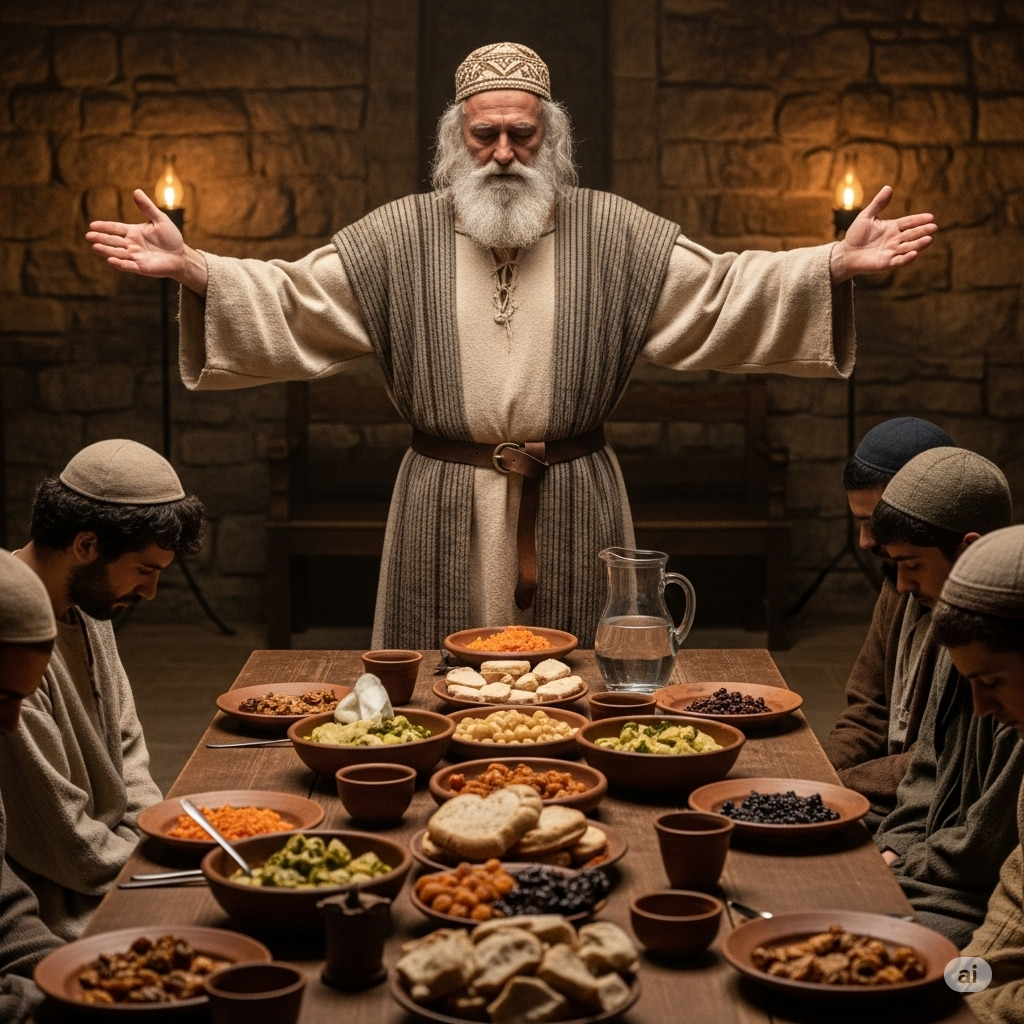
The Dead Sea Scrolls reveal a more complex and ritualized approach to meals. The Community Rule (1QS 6:2–5) and the Rule of the Congregation (1QSa 2:17–22) provide evidence of formal blessings before meals, usually led by a priest:
“Whenever they arrange the table to eat or the wine to drink, the priest shall extend his hand first to bless the first (portion) of the bread or the wine…” (1QS 6:4–5)
“…the Priest shall be the first to extend his hand to bless the first (portion) of the bread and the new wine with the blessing of God…” (1QSa 2:17–18)
These texts suggest a structured liturgical ritual in which blessings precede consumption. The ritual is priestly in nature, emphasizing order, purity, and hierarchy. The presence of the Messiah of Israel in 1QSa reflects eschatological overtones, indicating that meals in this community had both immediate and symbolic religious importance.
Notably, no post-meal blessing is described in these texts. This could mean either that no such blessing was required or that the pre-meal blessing was considered sufficient sanctification. Alternatively, the omission may reflect the fragmentary nature of the texts or the assumption that post-meal blessings were customary and thus did not need reiteration.
4. Josephus and the Essenes: A Witness to Dual Practice
Josephus offers a third perspective in The Jewish War (2.129–131), in his description of the Essenes:
“…a priest says grace before meat… The same priest, when he has dined, says grace again after meat… when they begin, and when they end, they praise God, as he that bestows their food upon them.”
Here, both pre- and post-meal blessings are explicitly attested. The Essenes, in Josephus’ description, treat the meal as a sacred act, akin to temple worship. The blessing before the meal may be seen as an act of sanctification, and the blessing after, as an expression of gratitude. Josephus, writing in Greek for a Roman audience, uses the language of “grace” (χάρις), perhaps to bridge Jewish and Greco-Roman religious concepts, but his account aligns closely with Jewish liturgical patterns.
If the Essenes reflect a branch of the broader Qumranic movement, Josephus’ evidence may suggest that both pre- and post-meal blessings were practiced in some or all sectarian contexts—although his report may also reflect idealization or harmonization with broader Jewish norms.
5. Discussion: Developing Trajectories of Practice
The contrast between Deuteronomy 8:10 and later Second Temple sources raises critical questions. Was the original biblical mandate later expanded to include a blessing before meals? Or was the blessing-before-meal an independent development, possibly influenced by priestly or purity concerns?
Several trajectories may be proposed:
Original practice: only after eating. This is the explicit biblical requirement, grounded in covenantal gratitude.
Later priestly innovation: blessing before eating. The DSS texts support the idea that priests (or messianic figures) instituted blessings prior to consumption as part of sanctifying food and ritual purity.
Integrative practice: both before and after. By the time of Josephus, some Jewish groups had adopted both practices, possibly influenced by temple liturgy, increasing formalization of meals, or broader Hellenistic religious sensibilities emphasizing both praise and sanctification
7. Rethinking Deuteronomy 8:10: Gratitude as an Ethical Disposition, Not Legal Formalism
While Deuteronomy 8:10 is frequently cited as the foundational source for the practice of blessing after meals, a closer reading suggests that the verse may not have been intended as a narrowly defined liturgical instruction. Rather, it fits into a broader ethical and theological framework that exhorts Israel to maintain awareness of God as the ultimate provider, especially in the context of abundance.
“When you have eaten and are satisfied, you shall bless YHWH your God for the good land which He gave you.”
The structure of Deuteronomy 8 as a whole emphasizes memory, humility, and the dangers of prosperity-induced forgetfulness (vv. 11–17). The command to “bless” appears not as a legal formula for a benediction, but as a moral imperative: to cultivate an attitude of thankfulness and to avoid attributing success to one’s own power. The object of the blessing—“for the good land which He gave you”—highlights national and historical gratitude more than specific ritual performance.
This reading finds support in the flexible usage of the verb ברך (barakh) throughout biblical literature, where it often denotes praising, thanking, or invoking divine favor in a general sense (e.g., Gen 24:27, Ps 103:1–2), rather than reciting a set formula. The emphasis is on relational posture, not ritual precision.
7.1 Second Temple Literalism and the Codification of Practice
In contrast to this Deuteronomic ethos, certain currents within Second Temple Judaism—particularly in sectarian groups such as those at Qumran—began to read biblical texts with increasing legal literalism. As legal systems developed and priestly authority expanded, vague or broad moral imperatives were reinterpreted as concrete prescriptions.
The Dead Sea Scrolls exemplify this phenomenon. The Community Rule (1QS) and Rule of the Congregation (1QSa) transform communal meals into highly structured, priest-led rituals, with blessings mandated before each portion of bread and wine. These are not spontaneous acts of thanks, but formalized rites embedded in a rigid system of purity and hierarchy. The blessing becomes an institutional obligation rather than a personal or ethical expression.
This tendency mirrors broader patterns in Second Temple exegesis, where even brief or ambiguous biblical phrases could give rise to expansive halakhic traditions. As Jacob Neusner and others have noted, sectarian Judaism often engaged in what may be called “hypernomian” reading—seeking divine will not only in explicit laws but in every textual detail, leading to an inflation of legal obligations beyond the likely intent of the biblical authors.
7.2 A Contrast in Theology
The biblical command appears to envision an agricultural society with informal worship centered on covenantal consciousness. In this context, blessing God “after you have eaten and are satisfied” does not imply a mandatory liturgical utterance, but rather an ethical response to material comfort. It seeks to shape the Israelite’s character—toward humility and acknowledgment of divine beneficence—rather than regulate meal rituals per se.
In contrast, the formalized blessings in Qumran and later rabbinic tradition reflect different priorities: precision, community identity, and institutional religious authority. While such developments are understandable in historical and theological context, they arguably mark a departure from the spirit of Deuteronomy 8:10, which promotes mindfulness and gratitude as inner dispositions rather than outward rites.
Certainly. Here’s a continuation of the same section, smoothly integrated, showing how rabbinic Judaism—especially in the Land of Israel—developed daily blessings as an expansion of the biblical ethic of gratitude. The point is to contrast Second Temple literalism with a later rabbinic move toward cultivating constant mindfulness and gratitude in line with Deuteronomy 8:10‘s spirit.
7.3 Rabbinic Expansion: Daily Blessings as Gratitude-Inspired Praxis
In contrast to the sectarian tendency of Second Temple groups to formalize isolated verses into ritual obligations, rabbinic Judaism—particularly in its early Palestinian expressions—developed a more holistic response to the commandment in Deuteronomy 8:10. Rather than fixating solely on the after-meal context, the rabbis sought to instill a broader disposition of berakhah (blessing) throughout the day and across all areas of life.
The Mishnah and Talmud record a proliferation of blessings—not only before and after eating, but upon seeing natural wonders, hearing good or bad news, smelling fragrant herbs, putting on new clothes, using the toilet, and waking up in the morning. The famous list of morning blessings (birkhot ha-shachar) reflects this development, with each line acknowledging a specific divine benefit: sight, mobility, clothing, freedom, energy. This liturgical layering seeks to fulfill the deeper ethical impulse of Deuteronomy 8—not merely to offer gratitude after eating, but to make thanksgiving the rhythm of life.
The Jerusalem Talmud (Talmud Yerushalmi), composed in the Land of Israel, is especially rich in these kinds of blessings. Its traditions preserve many unique benedictions that do not appear in the Babylonian Talmud and are no longer practiced, yet they reflect the minhag Eretz Yisrael (custom of the Land of Israel). Examples include blessings upon seeing specific flowers in bloom, entering towns or cities, or even meeting certain kinds of people. These reflect a religious culture deeply embedded in the rhythms of the land, nature, and daily social experience.
This liturgical creativity is not an abandonment of the biblical text but a fulfillment of its moral thrust. Where the Torah commands blessing “after eating and being satisfied,” the rabbis understood this as an invitation to develop a life of constant awareness, humility, and praise. In this way, the rabbinic tradition—especially in the Land of Israel—may be seen as more faithful to the intent of the biblical command than the more rigid, literalistic interpretations that arose during the Second Temple period.
Rather than reducing the verse to a rule about mealtime procedure, rabbinic Judaism broadened its theological implications. The result is a Judaism in which blessing is not just a ritual act but a mode of consciousness, echoing the biblical concern that Israel “not forget YHWH” amid prosperity (Deut. 8:11–14). Every moment of provision, encounter, or experience becomes an opportunity to affirm divine presence and human dependency.
8. Conclusion
The original practice according to the Torah appears to mandate a blessing after eating, centered on expressing thanks to God for the land and sustenance. The Qumran texts reflect an earlier form of pre-meal blessing, focused on priestly mediation and community order, while Josephus’ account of the Essenes reveals the most developed form of dual blessings—both before and after meals.
This trajectory suggests a liturgical evolution in Second Temple Judaism, in which meals took on greater ritual significance. The interplay between Deuteronomic theology, sectarian purity, and priestly structure laid the groundwork for later rabbinic halakhah, which codified both blessings as essential components of Jewish life.
Bibliography
Schiffman, Lawrence H. Reclaiming the Dead Sea Scrolls. Doubleday, 1994.
Baumgarten, Joseph M. Studies in Qumran Law. Brill, 1977.
Satlow, Michael L. Creating Judaism: History, Tradition, Practice. Columbia University Press, 2006.
