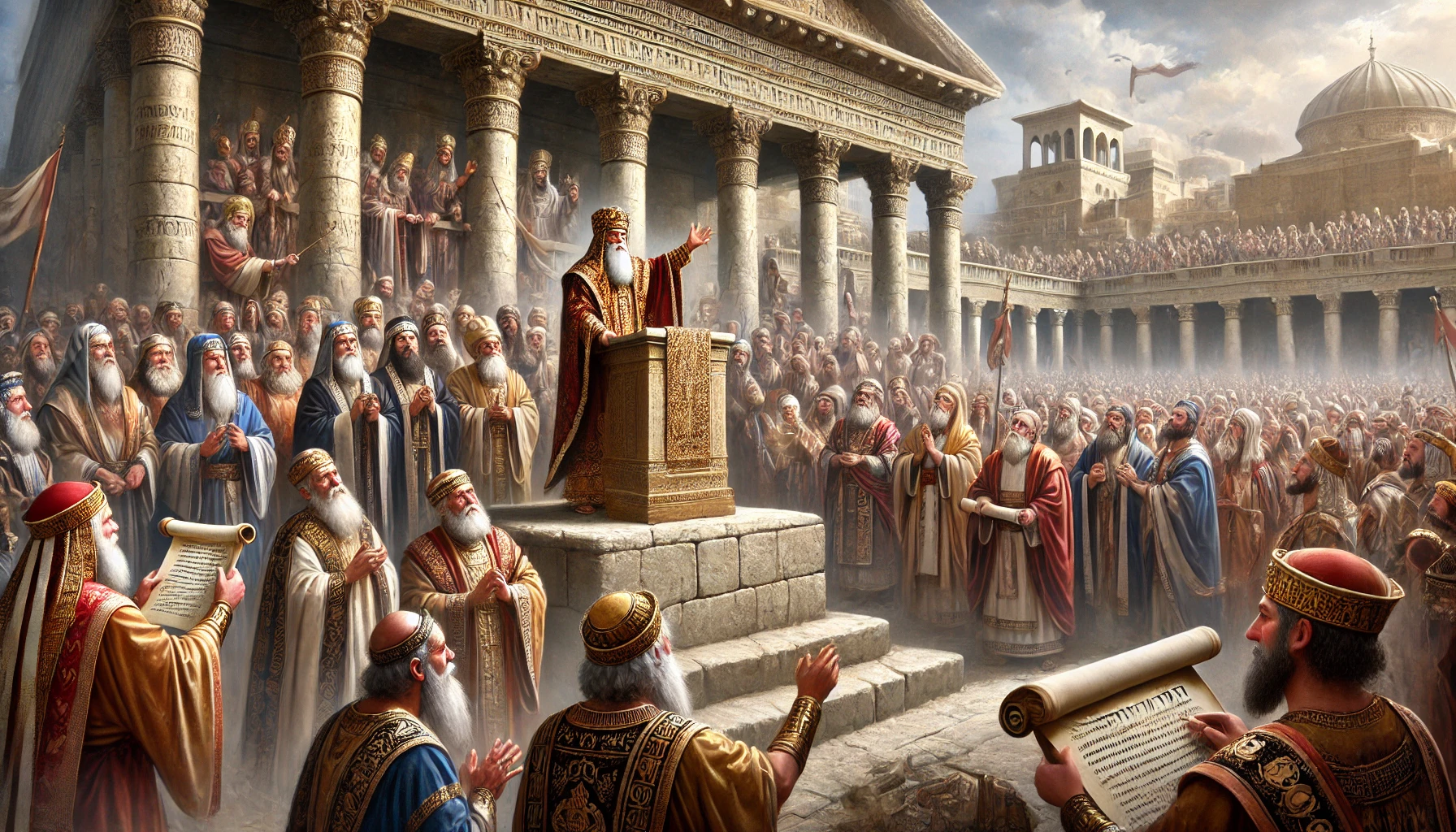
The word חשמן and its connection to the name חשמונאים (Hasmoneans) is a fascinating topic that ties together Biblical, linguistic, and historical elements.
Appearance of חשמן in the Bible
The word חשמן first appears in Psalm 68:32, where it is typically translated as “nobles” or “distinguished ones”:
“יָבוֹאוּ חֲשְׁמַנִּים מִנִי מִצְרָים כּוּשׁ תָרִיץ יָדָיו לֵאלֹהִים” (“Nobles shall come from Egypt; Cush will hasten to stretch out its hands to God.” – Psalm 68:32)
In this context, חשמן refers to prominent or noble individuals. The root of the word, חשמ, is associated with importance, wealth, or distinction. Scholars have linked it to the Akkadian term ḥasinnu, which means “wealthy” or “powerful,” suggesting a broader Semitic context for its meaning of authority and prominence.
In post-Biblical Hebrew, the term חשמן evolved to denote high-ranking individuals, such as nobles or rulers. In medieval Hebrew, it was eventually applied to Christian cardinals, signifying their high status within the church hierarchy.
The Name חשמונאים
The name חשמונאים (Hasmoneans) refers to the dynasty founded by the Maccabees, who led the Jewish revolt against Seleucid oppression in the 2nd century BCE. The origin of the name is traditionally linked to an ancestor of the family named חשמון (Hasmon). While the Bible does not explicitly mention this name, Rabbinic literature, such as the Mekhilta de-Rabbi Ishmael, identifies Hasmon as the progenitor or place of origin for Matityahu (Mattathias), the father of the Maccabees.
Possible Etymologies for חשמון
- Shared Root: The root חשמ, appearing in חשמן (“nobles”) in Psalms, could also relate to the name חשמון, suggesting a connection to prominence or distinction. This would align symbolically with the Hasmoneans’ role as leaders and defenders of Jewish sovereignty and tradition.
- Geographical or Clan Name: The name חשמון may have originally been a place name. It was common in ancient Israel to identify individuals or families by their geographic roots. If Hasmon was a location, the name חשמונאיםwould simply mean “those from Hasmon.”
- Symbolic Meaning: Another possibility is that the name חשמון carries a symbolic weight, emphasizing the family’s authority and their role as noble leaders.
Connection Between חשמן and חשמונאים
While there is no direct textual connection between the term חשמן in Psalms and the name חשמונאים, the shared root חשמties them together conceptually. Both terms reflect ideas of prominence and leadership:
- חשמן in Psalms refers to nobles or distinguished individuals, likely evoking a sense of power or status.
- The Hasmoneans were prominent leaders and defenders of Jewish independence, earning their place in history as “nobles” of their time.
The Hasmoneans’ victory over the Seleucid Empire during the Maccabean Revolt (167–160 BCE) and their subsequent establishment of a Jewish dynasty further reinforced their association with leadership and nobility. The Hasmonean reign marked a period of Jewish sovereignty and religious revival. As defenders of Jewish faith and independence, the Hasmoneans became synonymous with leadership and nobility, aligning with the connotations of חשמןas “nobles.”
Hasmonean Hegemony
Shimon the Hasmonean, one of the sons of Mattathias and brother of Judah Maccabee, was elected as the leader and high priest of Judea following a period of political turmoil and military successes. The details of his election and the terms of his authority are outlined in 1 Maccabees 14:25-49, rather than 2 Maccabees. This distinction is important because 1 Maccabees is a more comprehensive historical account of the Hasmonean period, while 2 Maccabees focuses more on earlier events and emphasizes religious themes.
Election of Shimon
In 1 Maccabees 14:25-49, we are told that a great assembly of priests, elders, and the people officially appointed Shimon as their leader and high priest. This took place in 140 BCE during a time of relative stability, after Shimon had achieved notable victories against Seleucid forces and secured Judean autonomy. The text highlights the assembly’s recognition of Shimon’s leadership as a continuation of the Hasmonean family’s efforts to liberate and protect Judea.
Shimon was given the titles:
- Leader (hegemon) – Over the political and military affairs of Judea.
- High Priest – Over the religious functions of the Temple.
- Ethnarch – Essentially the political head of the Jewish people.
Limitations on the Election
The assembly’s decree explicitly states that Shimon’s leadership would last “forever until a trustworthy prophet should arise” (1 Maccabees 14:41). This clause reflects a significant tension in the Hasmonean era. The people recognized the need for a strong and stable leader, but they also acknowledged the absence of prophetic guidance, which traditionally had been a cornerstone of leadership and divine authority in Israel.
The phrase “until a trustworthy prophet should arise” indicates:
- A recognition that Shimon’s authority was a practical, human solution to the immediate needs of the nation, not necessarily a divinely ordained one.
- An expectation of the eventual reappearance of prophecy, which had ceased during the Second Temple period.
- A built-in limitation on the Hasmonean rule, suggesting that their authority was provisional rather than absolute.
The Assembly’s Decree
The decree was formalized in writing and displayed publicly. It praised Shimon and his family for their bravery, leadership, and service to the Jewish people. It also detailed their accomplishments, including military victories, the rebuilding of the walls of Jerusalem, and the restoration of peace.
The decree solidified Shimon’s legitimacy and authority, combining popular consent with religious approval, though it was understood that his leadership was not intended to supplant the ultimate hope for divine guidance through a prophet.
Conclusion
The word חשמן, as it appears in Psalm 68:32, denotes nobles or prominent individuals, rooted in a Semitic concept of wealth and authority. The name חשמונאים, while primarily a family or geographic name, shares a linguistic and symbolic connection with this root, emphasizing the Hasmoneans’ status as leaders of their people. Together, these terms illustrate a continuity of ideas surrounding nobility and prominence in both Biblical and historical contexts which might relate to the title of the family as receiving hemogeny but not full kingship.
Suggested Reading
Bickerman, Elias J. The Maccabees: An Account of Their History from the Beginnings to the Fall of the House of the Hasmoneans. Schocken Books, 1979.
Grabbe, Lester L. Judaic Religion in the Second Temple Period: Belief and Practice from the Exile to Yavneh. Routledge, 2000.
Tcherikover, Victor. Hellenistic Civilization and the Jews. The Jewish Publication Society, 1959.
VanderKam, James C. From Joshua to Caiaphas: High Priests after the Exile. Fortress Press, 2004.
