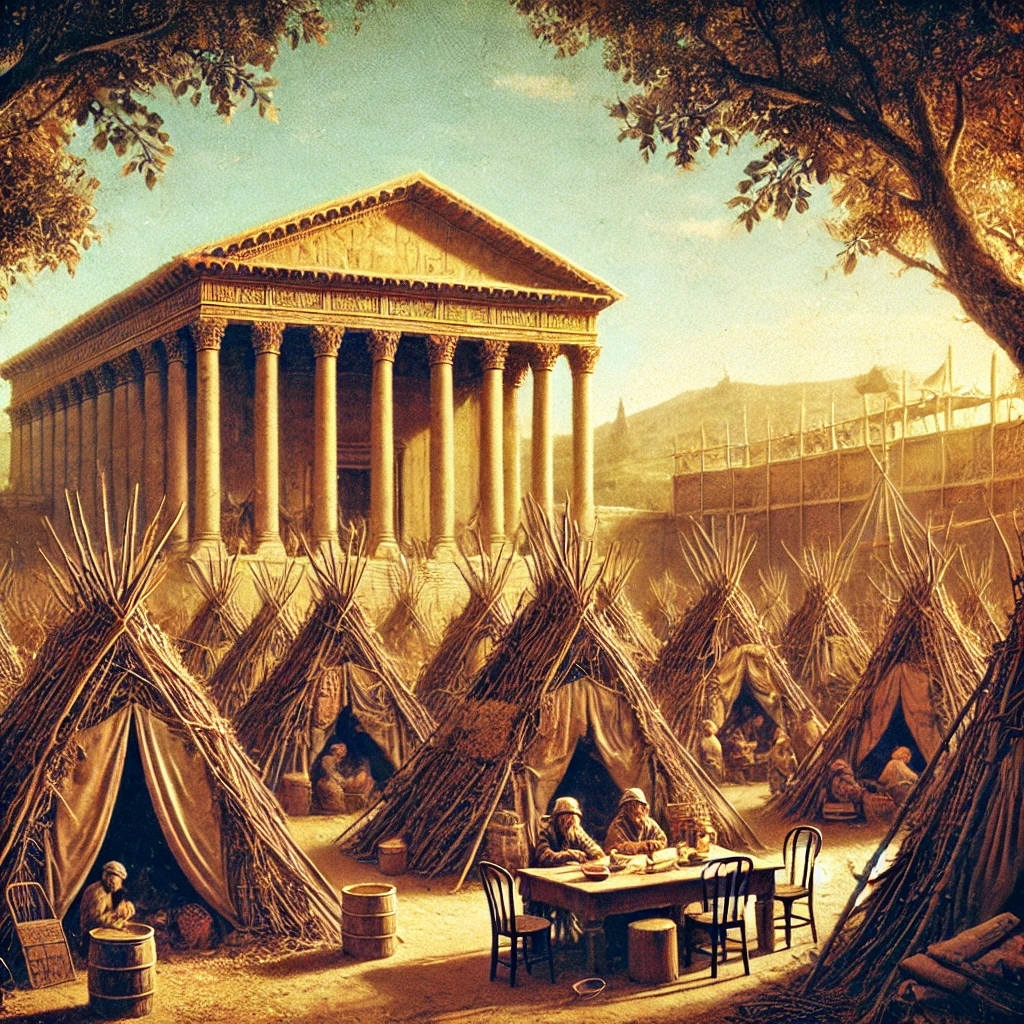
The interpretation of the four species (arba minim) mentioned in Leviticus 23:40 has been a central topic of debate among various Jewish groups, particularly in the context of Sukkot (the Feast of Tabernacles). The traditional rabbinic interpretation contrasts sharply with the Karaite and Samaritan perspectives, which emphasize a more literal reading of Nehemiah 8:15. This paper aims to examine these interpretations in detail, addressing the definitions, discrepancies, and underlying issues in both approaches.
The Definition of “Sukkah”
One common misconception that arises annually is related to the definition of a “sukkah” (סֻכָּה), often misunderstood as any temporary structure, leading some to construct tents (אֹהֶל, ohel) during Sukkot. However, Hebrew lexicons and ancient sources differentiate between a sukkah and a tent. A sukkah is specifically defined as a temporary structure, typically made from natural materials such as branches and leaves, used by farmers in the field for shade and shelter during the harvest season. It differs from an ohel in that its roof is not made of cloth but of organic material like plants.
In contrast, tents in ancient Israelite and Semitic cultures were not considered temporary dwellings; they were durable, semi-permanent structures used by nomadic peoples, like the Bedouin, to this very day. This distinction is critical to understanding why the Torah prescribes the construction of a sukkah from natural, readily available materials, aligning it with agricultural practices, and potentially tying it to the use of the four species mentioned in Leviticus 23:40.
Nehemiah 8:15 and the Use of Plants for Sukkah Construction
The passage in Nehemiah 8:15 has sparked significant discussion due to its seeming suggestion that the four species should be used for sukkah construction:
“Go out to the mountain and bring olive branches, and branches of wild olive (or pine), myrtle branches, palm branches, and branches of thick trees, to make booths, as it is written.”
This directive differs from the instructions found in Leviticus 23:40, which commands the Israelites to take the four species—pri etz hadar (fruit of a goodly tree), kapot temarim (branches of palm trees), anaf etz avot (boughs of thick trees), and arvei nachal (willows of the brook)—for rejoicing before God.
The Nehemiah passage mentions five different types of plants, not four, and while it is tempting to connect the two passages, the differences between them are notable. For instance, Nehemiah mentions the use of olive branches, which are absent from the Leviticus account. Additionally, the Nehemiah text focuses on the materials for constructing booths, whereas Leviticus speaks of taking these species for rejoicing, with no indication that they were to be used as building materials.
This raises the question of whether the post-exilic Jewish community understood the four species as part of the sukkah’s construction, or whether they were applying local customs influenced by their agrarian lifestyle, which may have led to different practices than those described in the Torah.
Methodological Note on Biblical Interpretations
Rabbinic interpretation generally views the four species as part of the ritual for rejoicing before God during Sukkot, separate from the construction of the sukkah. However, the Karaite interpretation, which often prioritizes the plain meaning (*peshat*) of the biblical text, suggests that the four species were intended for sukkah construction, as implied by Nehemiah.
This distinction between the two approaches reflects a broader methodological difference. Rabbinic tradition includes centuries of oral interpretation and legal refinement, while Karaites reject rabbinic authority and rely solely on the written Torah. However, it should be noted that Karaite law is not purely literalist and does involve interpretative decisions, often adding its own explanations to biblical texts.
The Karaite Interpretation
The Karaite interpretation of Leviticus 23:40 emphasizes the practical use of the four species in sukkah construction, largely based on Nehemiah 8:15. According to Karaite scholars, the fact that the Nehemiah text explicitly links the collection of specific plants with the construction of booths suggests that this was the intended purpose of the four species mentioned in the Torah. The Karaites maintain that the command to “take” these species in Leviticus refers to their use in constructing the sukkah itself, rather than as part of a ritual for rejoicing.
Karaite exegesis asserts that Nehemiah’s generation, in their return to Zion and their effort to reestablish Torah observance, accurately understood the practical applications of the Torah’s laws. The addition of olive branches and the term “as it is written” are interpreted as a natural extension of the agricultural practices of the time, aligning with the ancient need to build temporary structures from local materials during the harvest season.
Karaite criticism of rabbinic interpretation centers on the notion that the rabbinic tradition introduces a ritualistic and sometimes mystical element that is not rooted in the plain meaning of the text. Karaites argue that the Torah’s laws should be understood in a straightforward, literal sense, and that the rabbinic interpretation of the four species as symbolic objects used in a waving ritual is a later innovation not present in the original biblical text.
Problems with the Karaite Interpretation
While the Karaite interpretation presents a seemingly logical reading of Nehemiah, it is not without its own difficulties. First, the number of species in Nehemiah does not match the four species listed in Leviticus, which raises questions about whether the two texts are referring to the same practice. The addition of olive branches in Nehemiah, for instance, complicates the alignment between the two texts, as olives are not mentioned in the Leviticus account.
Second, the Karaite view faces challenges in explaining why Leviticus 23:40 mentions “taking” the four species without any explicit mention of sukkah construction. The absence of the verbs for “building” or “making” a sukkah in Leviticus further weakens the claim that the four species were intended as construction materials. The root used in Leviticus for “taking” (לקח) and the emphasis on rejoicing (שמח) suggest a ritualistic act rather than an instruction to gather building supplies.
Additionally, the lack of historical evidence for the widespread use of the four species in sukkah construction outside of Karaite communities suggests that this interpretation may not have been the original practice. While the Karaites offer a coherent system based on their reading of the text, their interpretation does not account for the broader ritualistic and agricultural context found in ancient Israelite culture.
The Problems with Rabbinic Interpretation
Rabbinic interpretation, while more aligned with ancient ritualistic traditions, is not without its own challenges. The rabbinic focus on the symbolic meaning of the four species and the elaborate waving rituals described in later texts, such as the Talmud, may seem disconnected from the original agrarian context in which these species were collected. Moreover, the rabbinic interpretation sometimes introduces elements of mysticism and spiritual symbolism, which may obscure the practical applications of these plants in the agricultural life of ancient Israel.
However, rabbinic tradition does offer explanations grounded in ancient Near Eastern practices, such as the use of palm branches in festive celebrations, as seen in various biblical and extra-biblical sources, including 2 Maccabees and Josephus. While the ritualistic waving of the four species may have evolved over time, the rabbinic interpretation preserves the core idea of rejoicing before God, which remains central to the celebration of Sukkot.
Ancient sources
In the Book of Jubilees (16:29-31), the use of the four species during the Festival of Tabernacles (Sukkot) is connected to Abraham’s celebration after the birth of Isaac. The text describes how Abraham observed the festival and offered thanks to God with specific plant species:
In Jubilees 16:29-31, we find a description of Abraham celebrating the Feast of Tabernacles (Sukkot) after the birth of Isaac. The passage highlights how Abraham observed the festival using plant species similar to those mentioned in Leviticus. The text reads:
“And he built booths for himself and for his servants on this feast, and he was the first to celebrate the Feast of Tabernacles on the earth. And during these seven days… he took branches of palm trees, and the fruit of goodly trees, and every day going round the altar with the branches, seven times a day in the morning, he praised and gave thanks to his God for all things in joy.”
This passage connects the ritual use of the four species to the joyful celebration of Sukkot by Abraham. While Jubilees does not explicitly list all four species, it mentions palm branches and other plant materials used in building booths and offering thanksgiving to God. It highlights that Abraham was the first to observe this festival, emphasizing its deep covenantal roots. This reinforces the importance of Sukkot as a time of gratitude and renewal, as well as the ritual use of plants to mark the occasion. While the text does not directly mention all four species as listed in Leviticus 23, it parallels the ritual practice of using these plants in the celebration of Sukkot, including rabbinic descriptions of surrounding the altar with branches and celebrating near the altar. This connection between the four species and Abraham highlights the longstanding tradition of associating these plants with joy and spiritual observance, even from the patriarchal era. Jubilees links the festival to a covenantal relationship with God, underscoring the religious importance of these species as tools for divine rejoicing.
Philo of Alexandria and Josephus provide valuable descriptions of the four species, offering insights into how these elements of the Sukkot celebration were understood in the Second Temple period. Philo, in his Special Laws (1:196-198), interprets the four species symbolically, seeing them as representing the harmonious unity of nature. He explains that the palm, myrtle, willow, and citron are linked to different elements of creation, with the palm symbolizing uprightness, the myrtle symbolizing symmetry, and the willow representing the waters that sustain life. Philo emphasizes the importance of these species in fostering a sense of gratitude toward the Creator. Josephus, in his Antiquities of the Jews (3.245), also describes the four species as central to the Feast of Tabernacles, focusing more on their use in celebratory processions. He mentions how the Jews carry the branches in their hands while giving thanks to God for the abundance of their harvest, framing the ritual as a communal expression of joy and thanksgiving. Both Philo and Josephus highlight the importance of the four species, though Philo’s interpretation leans toward the philosophical and symbolic, while Josephus focuses on the practical and ritualistic aspects of the ceremony.
The use of the four species during the time of the Bar Kokhba revolt provides fascinating insight into the persistence of Jewish ritual practices, even amidst conflict. The Bar Kokhba letters reflect the importance of observing Sukkot during the rebellion. In one letter, Bar Kokhba himself writes to his subordinates with urgent instructions regarding the four species: “Send us lulavim and etrogim” (4QApoc. Bar Kokhba Letters). This request emphasizes that even during a time of war, the observance of religious commandments, such as the waving of the four species, was a priority for the Jewish soldiers. Another letter also demands the collection of the species for the festival: “Bring to me palm branches and citrons for the men of the camp.” These letters not only highlight the commitment of Bar Kokhba’s army to Jewish law, but they also illustrate how central the rituals of Sukkot were to the Jewish identity and resistance during the revolt, serving both spiritual and national purposes. This enduring attachment to the four species underscores the deep connection between the celebration of Sukkot and the expression of Jewish unity and defiance in the face of Roman oppression.
Conclusion
In conclusion, the use of the four species in the Sukkot festival, as described in Leviticus 23:40, has evolved through various interpretations and practices in Jewish history, with significant diversity across different traditions. Rabbinic, Karaite, and Samaritan interpretations differ in their identification of the four species and their application in ritual, reflecting broader differences in how Jewish groups have approached Torah observance. While some scholars have speculated about fertility ritual connections, the waving of the four species in the Torah is primarily linked to rejoicing before God, as opposed to any fertility-oriented purpose. The development of ritualized practices, especially in the Rabbinic period, shows how Sukkot and its customs were enriched and transformed in post-Second Temple Judaism.
Historical sources, such as Jubilees, Josephus, and Philo, demonstrate that the four species were integral to Jewish religious life both during and after the Second Temple period. The practice of waving the species is attested to across these texts, underscoring its continuity and significance throughout history. Even during times of Jewish struggle, such as the Bar Kokhba revolt, the soldiers continued to observe Sukkot and use the four species, as revealed in the letters from that period, showing their deep-rooted cultural and religious identity. Lastly, Jubilees offers a unique perspective by linking the celebration of Sukkot back to the patriarch Abraham, emphasizing the antiquity and foundational nature of the practice. The description of Abraham using branches and circling the altar reflects a broader theme of continuity and tradition, reinforcing the significance of the four species not just as a biblical command but as part of a historical and ritual legacy that spans centuries.
Together, these sources demonstrate that the four species, and their associated rituals, are not merely legalistic prescriptions but are woven into the fabric of Jewish spiritual life, serving as symbols of joy, identity, and religious expression across generations.
Notes:
[1] קדרי מנחם, מילון העברית המקראית, בר-אילן 2007, עמ׳ 754. Also see J.Milgrom, Anchor Leviticus, Yale 2001, pp.2048-2050
[2] It is important to note that the Etrog/Citron is not native to Israel, and was an import from Persia. The Talmud in Sukkah 14:b deals with people who bring other fruit such as Pomegranates. Dr. Zohar Amar of Bar Ilan University has done extensive work on this topic.
[3] As demonstrated by Sarah Yeffet in many of her works in the book of Chronicles.
[4] Rashi, Radaq, and other various Jewish commentators. However, modern commentators reject this idea and explain that the Vav connected to the instruments is a conjunctive Vav, and not a detailing Vav of clarification.
[5] Sifrah on Emor chapter 17:10 ישבו בסוכות”– בסוכות של כל דבר. שהיה ר’ יהודה אומר, והדין נותן שלא תהא סוכה אלא מארבעת המינים- “They shall sit in Sukkot”- IN Sukkot (made) of anything. Because R. Yehudah says, the law seems that the Sukkah should not be built but (only) from the four species.
[6] רוזן-צבי, ישי, מבוא למשנה, בתוך ספרות חז״ל הארץ ישראלית, ירושלים 2018, עמ׳ 16
[7]תלמוד ירושלמי, סוכה פ״ג ה״ח
[8] Kochman M., Olam Hatankh-Nehemiah, pp.264-266
Originally Published: 15 October 2016
