Abstract
Malkizedeq is a mysterious and significant figure in the Hebrew Bible, mentioned in Genesis 14, Psalm 110, and later developed in the Dead Sea Scrolls. This paper explores the grammatical, theological, and literary complexities surrounding Malkizedeq’s role as a priest-king and his portrayal in these three contexts. The Genesis narrative’s ambiguous pronouns create interpretative challenges, raising questions about the interaction between Abram and Malkizedeq. Psalm 110 casts Malkizedeq as a priestly archetype, while the Dead Sea Scrolls present him as an eschatological figure. This paper examines how Malkizedeq’s figure evolved, focusing on linguistic and contextual analysis, ancient Near Eastern parallels, and the theological significance of his depiction.
0. Introduction
The biblical figure of Malkizedeq has captured the imagination of scholars and theologians for centuries due to his enigmatic appearances in three primary sources: Genesis 14, Psalm 110, and 11Q13 from the Dead Sea Scrolls. Malkizedeq, whose name means “king of righteousness,” appears as both a king and a priest, a dual role that sets him apart in biblical literature. His interaction with Abram (later Abraham) in Genesis, his mention in the royal hymn of Psalm 110, and his later messianic development in Second Temple literature have fueled diverse interpretations, ranging from theological speculation to grammatical analysis.
1. Melkizedeq in Genesis 14: Grammatical and Narrative Challenges
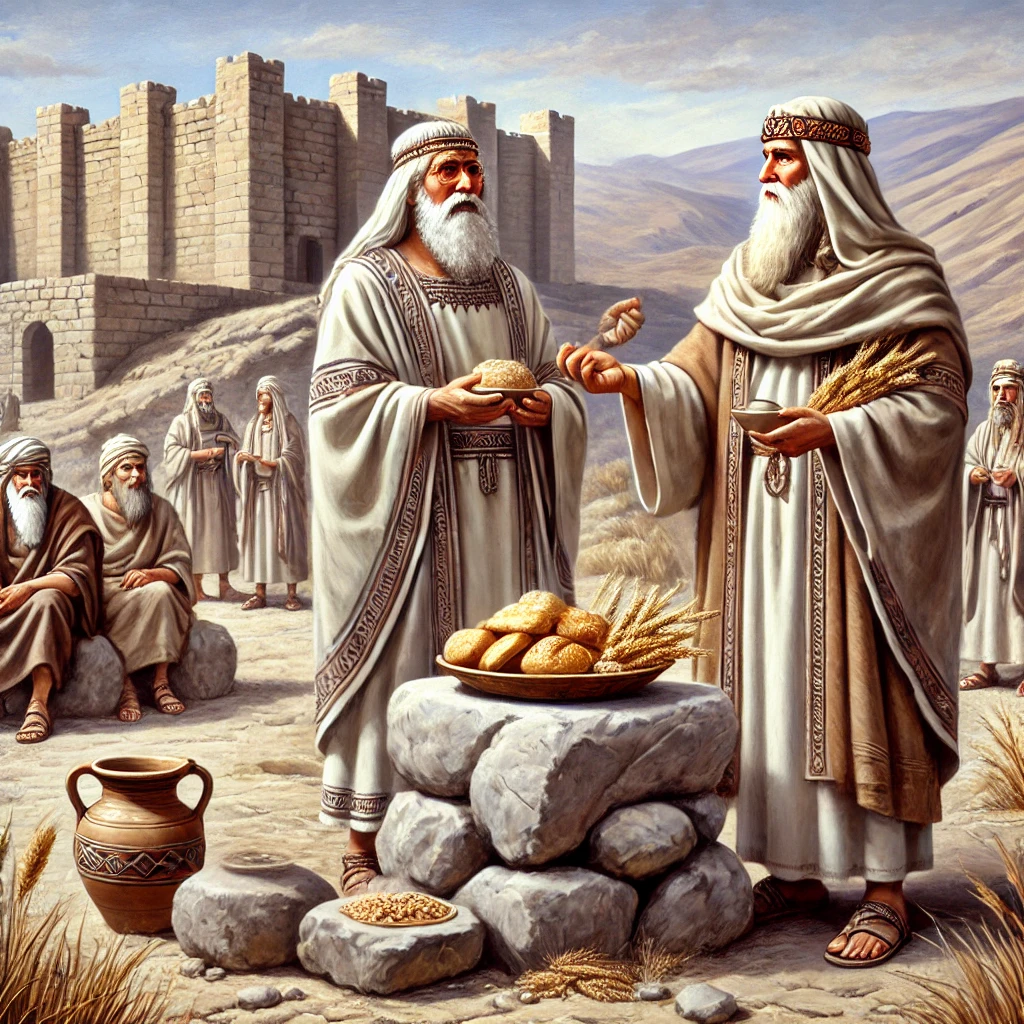
The earliest mention of Malkizedeq occurs in Genesis 14:18-20, where he is introduced as the “king of Salem” and “priest of God Most High” (אל עליון). In this passage, Malkizedeq blesses Abram and offers him bread and wine, followed by the phrase “וַיִּתֶּן לוֹ מַעֲשֵׂר מִכֹּל” (“he gave him a tenth of everything”). The ambiguity of the pronoun “לו” (lo, “to him”) has generated debate over whether Abram gave a tithe to Malkizedeq or Malkizedeq gave a tithe to Abram.
2.Traditional Interpretation
Traditionally, the passage has been understood to mean that Abram, in recognition of Malkizedeq’s priestly authority, gave him a tenth of the spoils from the battle against the kings. This interpretation aligns with later theological traditions in both Judaism and Christianity that view Malkizedeq as a superior priestly figure. According to this view, the tithe represents an acknowledgment of Malkizedeq’s unique status as both king and priest, which prefigures the priesthood of the Aaronic line or, in Christian theology, the priesthood of Jesus.
3.Grammatical Considerations
To provide a detailed explanation of the principle of “preservation of subject” in Biblical Hebrew and its implications for the narrative involving Malkizedeq and Abram, we can refer to the works of scholars like Y. Moraoka and S. Kogot. The principle of “preservation of subject” (also known as “subject continuity”) refers to a syntactic norm in Biblical Hebrew where the subject of a verb tends to remain consistent across consecutive actions or statements unless there is a clear indicator of a subject change. This principle ensures clarity in the narrative by allowing the reader or listener to follow the subject through a series of actions without needing to reinterpret the subject with each verb.
In the context of the encounter between Malkizedeq and Abram in Genesis 14:18-20, we observe the following sequence:
1. Malkizedeq’s Actions: He brings bread and wine and blesses Abram.
2. Verb Usage: The Hebrew text employs the verb וַיִּתֶּן (“he gave”) immediately following these actions.
Analysis of Genesis 14:18-20
The relevant Hebrew text reads:
וּמַלְכִּי-צֶדֶק מֶלֶךְ שָׁלֵם, הוֹצִיא לֶחֶם וָיָיִן; וְהוּא כֹהֵן, לְאֵל עֶלְיוֹן.
וַיְבָרְכֵהוּ, וַיֹּאמַר בָּרוּךְ אַבְרָם לְאֵל עֶלְיוֹן, קֹנֵה שָׁמַיִם וָאָרֶץ.
וּבָרוּךְ אֵל עֶלְיוֹן, אֲשֶׁר-מִגֵּן צָרֶיךָ בְּיָדֶךָ; וַיִּתֶּן-לוֹ מַעֲשֵׂר, מִכֹּל.
Here, the action of giving is attributed to an unspecified subject. However, given the established subject of Malkizedeq in the preceding clauses, it is reasonable to infer that he remains the subject of the verb “וַיִּתֶּן.”
4.Implications of This Reading
If Malkizedeq is indeed the subject of the verb “וַיִּתֶּן,” this suggests that he gave a tithe to Abram rather than the other way around. This act can be interpreted as a covenantal exchange—a recognition of Abram’s victory, which is depicted as divinely sanctioned. Such an interpretation resonates with the broader themes of divine favor and the establishment of covenantal relationships found throughout the Hebrew Bible. The context of the narrative further supports this reading. After the encounter with Malkizedeq, Abram refuses the spoils offered by the king of Sodom, indicating a clear distinction between the two encounters. Abram’s refusal of the king of Sodom’s gifts reinforces the notion that he is not interested in earthly rewards, but rather in divine blessings. Malkizedeq’s offering of bread and wine, followed by the blessing and the tithe, elevates Abram’s status as the recipient of divine favor rather than as a giver.
Scholars like Y. Moraoka and S. Kogot have highlighted the significance of Hebrew syntax in understanding these passages. Moraoka, in his studies of Biblical Hebrew, emphasizes that the preservation of the subject aids in maintaining narrative clarity, allowing for smoother interpretation without the potential confusion of shifting subjects. Kogot reinforces this by discussing how ignoring this syntactic principle could lead to misinterpretations of key narrative elements, such as who is giving and receiving within these divine encounters. The application of the “preservation of subject” principle in the analysis of Genesis 14:18-20 reveals that Malkizedeq is likely the one who gave a tithe to Abram, thus underscoring a significant theological and narrative moment. This interpretation aligns with the broader biblical themes of divine selection, covenantal exchange in the context of Malkizedeq’s character in the story.
5.Tithe?
The word “מעשר” is traditionally understood as “tithe,” referring to the giving of one-tenth of one’s produce or income, a practice mandated by the Torah, especially in Priestly contexts. However, when we examine the word’s broader Semitic roots, particularly in Ugaritic texts, it becomes evident that “מעשר” originally carries a more general meaning as “a portion” or “a share,” not necessarily restricted to the exact fraction of one-tenth.
In Ugaritic, a cognate of the Hebrew “מעשר” appears in various texts, but it is not limited to a strict tithe. Instead, the Ugaritic form ‘sr often denotes a portion, which could vary depending on the context.
In Ugaritic literature, the term related to the Hebrew “מעשר” can be found in the Ugaritic root ‘sr. This root does not strictly mean “tenth” as in the later Biblical Hebrew sense of a tithe, but rather denotes a “portion” or “share.” A specific reference to this can be found in the Ugaritic text KTU 4.56, where it mentions ‘asru as a portion given in tribute.
One example in the Ugaritic texts that uses the root ‘sr is found in KTU 4.56:14-15, which reads:
> “And he apportions the portions of the tribute (wealth).”
This term ‘asru is used in a context that refers to giving a share or portion as part of an offering or tribute, not a strict tenth, which reflects the broader use of the term in ancient Semitic languages.
Additionally, in KTU 4.14:16-17, the term ‘isruma appears in a list of offerings as part of ritual practices. Here, it again signifies a “portion” given, reinforcing the flexible nature of the term in Ugaritic usage, distinct from the more rigid sense of a tithe in later Biblical Hebrew.
These examples underscore that the concept of ‘sr as a “portion” rather than a strict tithe predates its narrower Priestly definition in the Hebrew Bible. All of this suggests that the concept of “מעשר” as a portion may have existed in a more fluid sense in earlier Semitic languages, evolving into the more rigid tenth required by the priestly legislation in later Biblical Hebrew.
This more flexible understanding of “מעשר” as a “portion” without the fixed connotation of a tenth aligns with the general practice of giving shares to deities or rulers in ancient Near Eastern societies, where exact quantities were not always specified. The Ugaritic texts show that such offerings could vary, reinforcing the idea that “מעשר” in its earlier usage did not necessarily imply a tenth.
6. Priestly Contexts and the Evolution of “Tithe”
In the Priestly (P) texts of the Torah, “מעשר” acquires a more specific and technical meaning, referring to the tenth of one’s produce or income that must be given to the Levites, as described in Leviticus, Numbers, and Deuteronomy. This tithe was a legal obligation, tied to the centralization of worship and the support of the priestly class, reflecting the needs of the evolving Israelite religious system. The distinction between these uses suggests that the fixed concept of a tithe (one-tenth) developed as part of the Priestly tradition (P source), which systematized and codified many of Israel’s religious practices. In this context, “מעשר” becomes part of a highly structured legal and sacrificial system, in contrast to its earlier, more flexible usage as seen in Ugaritic. When Melkizedeq interacts with Abram, the text states that Abram gave him a “מעשר מכל” (“a tenth of everything”). While later interpretations read this as a literal tithe, it is possible that, in its original context, it simply meant a portion, not bound to the strict tenth established later in the Priestly legislation.
7. Malkizedeq in Psalm 110: A Priestly Order or Divine Decree?
Psalm 110:4 further develops the figure of Malkizedeq, declaring: “YHWH has sworn and will not change His mind: ‘You are a priest forever, in the order of Malkizedeq.'” This passage has been the subject of extensive theological debate, particularly regarding its use of the term “priest” in reference to a royal figure. The phrase “כֹּהֵן לְעוֹלָם עַל דִּבְרָתִי מַלְכִּי-צֶדֶק” (“a priest forever according to the order of Melchizedek”) has traditionally been understood as a reference to a perpetual priesthood that transcends the Aaronic line. In Jewish interpretation, this verse has been associated with the Davidic monarchy, with the king assuming a priestly role as a representative of God on earth. In Christian interpretation, Psalm 110:4 has been central to the portrayal of Jesus as a high priest in the “order of Malkizedeq,” a theme elaborated in the New Testament book of Hebrews.
A key issue in interpreting this verse is the meaning of the word דִּבְרָתִי (divrati), which is often translated as “order” or “rank.” However, the root דבר (davar) typically means “word” or “speech.” Some scholars argue that a more accurate translation might be “according to my word,” indicating that the priesthood of Malkizedeq is established by divine decree rather than belonging to a specific lineage or order. This interpretation shifts the focus from an institutional priesthood to a divinely conferred role, suggesting that the king, like Malkizedeq, serves as a mediator of God’s will. The use of priestly language in this psalm may be metaphorical, reflecting the ancient Near Eastern tradition in which kings often performed religious functions. Thus, the Davidic king is described as holding both royal and priestly authority, echoing Malkizedeq’s dual role as king and priest.
The depiction of Malkizedeq in the Dead Sea Scrolls, particularly in 11Q13 (11Q Malkizedeq), reveals significant theological and eschatological developments that highlight his importance within the context of Second Temple Judaism. The transformation of Malkizedeq from a historical king-priest to an eschatological figure serves to address the community’s expectations for divine intervention in the face of evil.
8. Malkizedeq as an Eschatological Figure
Eschatological Reinterpretation: In 11Q Malkizedeq, Malkizedeq is portrayed not merely as a historical figure from the time of Abraham but as an eschatological agent of divine judgment. This text depicts him as presiding over the final judgment, a role that aligns with messianic expectations prevalent among some Jews during the second temple. The reinterpretation of Malkizedeq as a divine or quasi-divine being elevates him beyond his initial characterization in Genesis, where he is presented simply as a priest-king of Salem.
One of the central themes in 11Q13 is Malkizedeq ‘s triumph over Belial, the embodiment of evil in the Qumran literature. This confrontation symbolizes the broader cosmic struggle between the forces of good and evil, with Malkizedeq acting as the divinely appointed figure who will defeat evil. The association of Malkizedeq with this eschatological battle reflects a belief in a coming divine intervention that would ultimately restore righteousness and justice. The text draws a connection between Malkizedeq and the proclamation of liberty during the Jubilee year, as cited from Isaiah 61:1-2. This association positions Malkizedeq as a liberator, echoing themes of restoration and redemption that are integral to Jewish eschatological thought. Additionally, the linkage of Malkizedeq to the Day of Atonement reinforces his priestly role, suggesting that he not only delivers the righteous but also facilitates atonement for them. This dual function as liberator and priest highlights his significance in the context of salvation history. This linkage may also have been the inspiration for the Book of Hebrews which presents Jesus as a divine priest.
The portrayal of Malkizedeq in 11Q13 reflects the theological aspirations of the Qumran sect, which was grappling with the realities of oppression and the perceived absence of divine justice in their time. By envisioning Malkizedeq as an eschatological figure who will bring about the final restoration, the community articulated a hope for a future where divine justice prevails over evil. This eschatological interpretation responds to their socio-political context and the desire for a tangible agent of God’s will.
9. Broader Implications in Second Temple Judaism
The transformation of Malkizedeq’s identity from a historical king-priest to a messianic deliverer demonstrates how Second Temple Judaism expanded and reinterpreted biblical figures to meet contemporary theological needs. The Qumran community’s emphasis on Malkizedeq as a cosmic agent of justice reflects their aspirations for a messianic age characterized by divine sovereignty and righteousness. Malkizedeq’s elevated status in 11Q13 aligns with broader messianic expectations that emerged during the Second Temple period. Various sects within Judaism were anticipating a future figure who would restore Israel and establish God’s kingdom. By linking Malkizedeq with these eschatological themes, the 11Q13 contributed to the development of messianic thought within Judaism, which would later influence early Christian interpretations of figures like Jesus.
The reinterpretation of Melchizedek in the Dead Sea Scrolls has left a lasting impact on subsequent Jewish and Christian traditions. In Christianity, for example, the author of Hebrews explicitly connects Jesus to Malkizedeq, emphasizing the eternal priesthood and the fulfillment of messianic promises. This intertextuality demonstrates how the understanding of Malkizedeq evolved and was utilized to articulate theological concepts across different religious contexts. By reinterpreting Malkizedeq as an agent of divine judgment and salvation, the text reflects the community’s hopes for a future restoration and their understanding of the cosmic struggle between good and evil. This transformation illustrates how Second Temple Judaism adapted and expanded biblical figures to address the theological and existential challenges of their time, ultimately influencing later Jewish and Christian thought.
10.1QapGen
In the Genesis Apocryphon from the Dead Sea Scrolls (1QapGen), Malkizedeq’s appearance is brief but revealing. This text recounts parts of the Genesis narrative with certain expansions, offering insight into how some Second Temple authors interpreted key figures and events. In the Genesis Apocryphon, Malkizedeq is mentioned in the retelling of Abram’s (Abraham’s) encounter with him, yet his characterization is notably downplayed in comparison to other texts like the Book of Hebrews or 11QMelchizedek (11Q13).
11. Downplaying Malkizedeq’s Role
Unlike the portrayal in Psalm 110 or 11Q13, where Malkizedeq is elevated as a priestly or even messianic figure, the Genesis Apocryphon depicts him as a more conventional figure. His priestly function and role as king are acknowledged, but there is no suggestion of divine or supernatural qualities. This suggests that the Genesis Apocryphon may have aimed to preserve the more grounded, historical aspects of Malkizedeq rather than the eschatological or cosmic significance seen in other texts.
The Genesis Apocryphon shows Malkizedeq as bringing bread and wine to Abraham and then blessing him, which is consistent with the Biblical account in Genesis 14. However, it lacks any indication that Malkizedeq’s actions had cosmic or eternal significance. There is no association with a priestly “order” or with an everlasting priesthood as in Psalm 110. Instead, he is simply a priest of “El Elyon” (God Most High), and his role appears limited to acknowledging Abram’s status rather than reinforcing a divine covenant or priestly line through Malkizedeq himself.
12. Who Gives to Whom?
The Genesis Apocryphon follows the syntax ambiguity found in Genesis 14:20, which raises the question of who gives the tithe to whom. The text uses phrasing that still allows for both possible interpretations but subtly implies that Malkizedeq, as the established priestly figure, is the one giving to Abraham. This would be in line with the principle of “preservation of subject” that the text may have borrowed from traditional Hebrew grammar conventions.
In essence, the Genesis Apocryphon presents Malkizedeq as a figure who acknowledges Abram’s victory and blessing without the theological embellishments found in other texts. His role is downplayed to emphasize Abram’s divinely sanctioned victory and standing rather than portraying Malkizedeq as an ongoing intermediary between humanity and the divine. This version reflects a more restrained Second Temple view of Malkizedeq, providing a counterpoint to later interpretations that elevate him to quasi-divine status.
—
Conclusion
The figure of Melchizedek has undergone significant development from his initial appearance as a priest-king in Genesis 14 to his eschatological role in the Dead Sea Scrolls. While traditional interpretations have often focused on Abram’s supposed tithe to Melchizedek, a closer examination of the Hebrew syntax suggests that it may have been Melchizedek who gave a tithe to Abram. In Psalm 110, Melchizedek is used as a model for a royal priesthood, with the term דִּבְרָתִיsuggesting a divine decree rather than a formal priestly order. Finally, in the Dead Sea Scrolls, Melchizedek is elevated to a messianic figure who will bring about the ultimate redemption of Israel.
The word “מעשר” reflects a dynamic linguistic and cultural history. Its Ugaritic parallels suggest that the original meaning was more fluid, referring to a portion or share rather than a strict tithe. Only in the Priestly (P) context did “מעשר” come to mean a precise tenth, as part of the organized religious and sacrificial system. This insight helps to clarify certain ambiguous Biblical texts and enriches our understanding of how religious practices in ancient Israel evolved.
This study demonstrates the complexity of interpreting Melchizedek’s role in biblical and Second Temple literature. His figure serves as a bridge between royal, priestly, and eschatological themes, reflecting the evolving religious landscape of ancient Israel and early Judaism.
Bibliography
Barker, Margaret. The Great High Priest: The Temple Roots of Christian Liturgy. T&T Clark, 2003.
Boccaccini, Gabriele. Roots of Rabbinic Judaism: An Intellectual History, from Ezekiel to Daniel. Eerdmans, 2001.
Bruce, F.F. The Epistle to the Hebrews: The English Text with Introduction, Exposition, and Notes. NICNT. Eerdmans, 1990.
Collins, John J. Apocalypticism in the Dead Sea Scrolls. Routledge, 1997.
de Jonge, Marinus. Jesus, the Servant-Messiah. Yale University Press, 1991.
Del Olmo Lete, Gregorio, and Joaquín Sanmartín. A Dictionary of the Ugaritic Language in the Alphabetic Tradition. Leiden: Brill, 2015.
Emerton, John A. “Some Notes on the Ugaritic and Biblical Hebrew Words for ‘Tithe’” in Vetus Testamentum 13.4 (1963): 427-438.
Fitzmyer, Joseph A. The Genesis Apocryphon of Qumran Cave 1 (1Q20). Biblica et Orientalia 18/A. Biblical Institute Press, 2004.
García Martínez, Florentino, and Eibert J.C. Tigchelaar (eds.). The Dead Sea Scrolls Study Edition Vols. 1-2. Brill, 1997.
Horton, Fred L. Jr. The Melchizedek Tradition: A Critical Examination of the Sources to the Fifth Century A.D. Cambridge University Press, 1976.
Knibb, Michael A. The Qumran Community. Cambridge University Press, 1987. Schiffman,
Koehler, Ludwig, Walter Baumgartner, and Johann Jakob Stamm. The Hebrew and Aramaic Lexicon of the Old Testament. (HALOT), Vol. 2. Leiden: Brill, 2001.
Kogot, Shmuel. Between Syntax and Interpretation: Studies in Biblical Grammar and Exegesis. Jerusalem: Magnes Press, 2002.
Lawrence H. The Eschatological Community of the Dead Sea Scrolls: A Study of the Rule of the Congregation. Scholars Press, 1989.
Mason, Eric F. You Are a Priest Forever: Second Temple Jewish Messianism and the Priestly Christology of the Epistle to the Hebrews. Brill, 2008.
Moraoka, T. A Grammar of Biblical Hebrew. Rome: Pontificio Istituto Biblico, 2011.
Noth, Martin. Leviticus: A Commentary. Philadelphia: Westminster Press, 1965.
Pardee, Dennis. Ritual and Cult at Ugarit. Atlanta: Society of Biblical Literature, 2002.
Sarna, Nahum M. Genesis: The JPS Torah Commentary. Philadelphia: Jewish Publication Society, 1989.
